Category Archives: Uncategorized

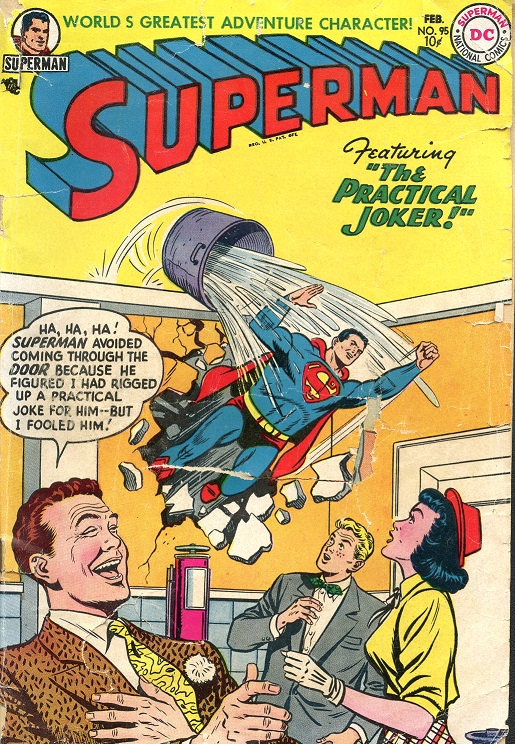
Superman? Not without a super woman.

superman

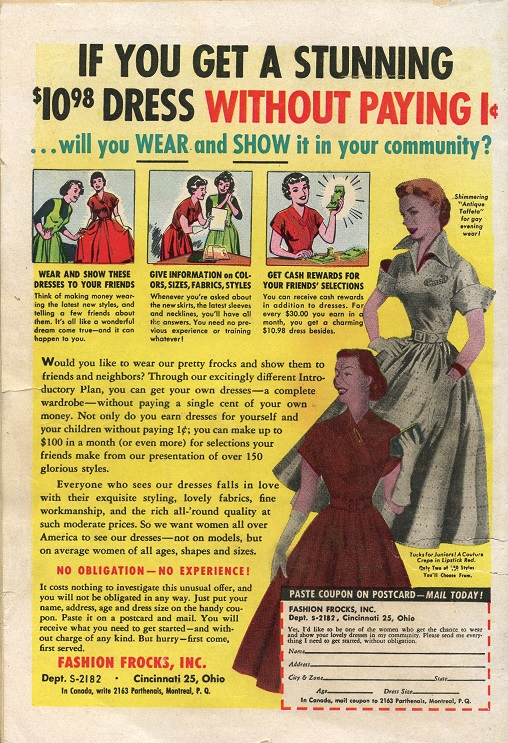
In February, 1955, the Superman comic book cost ten cents. That month, the back page carried an ad for Fashion Frocks. The headline read; If you get a Stunning $10.98 Dress Without Paying 1¢…will you WEAR and SHOW it in your community? It was like Tupperware marketing—without the parties. That ad clearly indicated that Fashion Frocks, Inc. believed that girls were reading the Superman comic book, and yet, National Comics (later known as DC Comics), opted to keep their female employees hidden from their readership.
fashionflair ad

In that same issue, right smack in the middle, there is a two-page article called, The Saga of the Soda: America’s Fountain Favorite Has Had a Remarkable Career, written by Ben Boltson. Only it wasn’t. It was written by Barbara Boltson, my mother. She was in her early twenties and not yet married. Despite the saccharine title, the article was not pure fluff. I don’t mean to imbue it with undeserved gravitas, but she had to have done some research in order to be able to explain the science behind carbonated water, as well as how to capture and deliver it for use at soda fountains. Fluff or not, it makes me sad to think that she had to forego her just deserts because National Comics wouldn’t allow women to publish under their own names.

After my parents married (which presumably would have caused my mother to be called Ben Mintz had she continued to work for National Comics), they moved to California and for a short time she worked for Western Family magazine where part of her job was delivering models to photo shoots. (She’ll blush to read this, but I remember a story about her car breaking down and the tow truck guy who came to help telling her that he had once towed Elizabeth Taylor and that Mom was prettier.) I have no doubt that if my mother had been born a few years later she would have had a marvelous career managing a magazine, or working as a writer or editor, but once she had her children, that no longer seemed to be an option.

And then, in the early 80s, I gave my mother a Commodore 64 computer. It was love at first sight, and before long she was running the Commodore Users Group of the Boston Computer Society and writing articles for RUN Magazine. She may not have worked outside the house, but she was a hell of a role model.
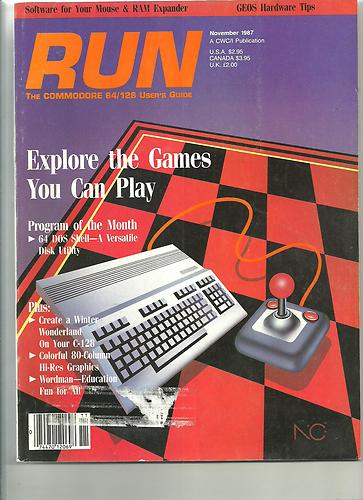
runmag

I have great admiration for my dad, and he’s always been one of my heroes, but if I needed someone to leap a tall building, Mom was the one I’d ask. She is modest to a fault and may well be embarrassed by all this attention, but from the first time I saw that Superman comic book with my mother’s pseudonymous byline, I knew I wanted to grow up to be like her. Things change; magazines no longer cost a dime, and women publish under their own names, but I continue to get inspiration from my mother.

Why do writers spend money?

It’s expensive to be a struggling writer; there are organizations to join, dues to be paid, subscriptions to maintain and conferences to attend. And the earlier you are in your journey to the holy grail of publication the more you tend to spend. In the beginning, I spent money to learn the craft, with classes online and at local writing enclaves like Grub Street. Then I started to attend conferences sponsored by the Society for Children’s Book Writers and Illustrators (SCBWI) so I could learn more about the business of publishing and broaden my network. After several years of that, I am reasonably confident that my work is solid and that I understand how the publishing game is played. You would think that would mean that I could save my money and stay home, but you’d be wrong. Writing is a lonely job, and the best way to combat that is to get out and mingle with other writers.

Last week, I was fortunate to be able to participate in a small conference in Rhode Island called Whispering Pines. The conference is sixteen or seventeen years old and is run under the auspices of the SCBWI and managed, in recent years, as a labor of love by an author named Lynda Mullaly Hunt. One of the many things she does to make the retreat a success is entice industry folks, agents, editors, authors and illustrators, to attend as mentors. Each attendee submits pages ahead of time that are then shared with one of the mentors who arrive at Whispering Pines ready to provide a critique. Every newbie hopes that they will have been assigned to an agent or editor who will love their work so much that they will sign them on the spot—until we discover that the best critiques come from the authors.

Agents and editors read hundreds, thousands, of query letters, first pages and partial manuscripts every year. The chances are that even if they started their careers as warm, nurturing, idealists, they’ve been worn down by the sheer volume of material they are bombarded with daily. As one editor explained, she can tell immediately if she’s interested in a submission—immediately. She scans the first paragraph and, most times, hits the delete key. Now, that doesn’t mean that she can’t give an excellent critique, but explaining why a non-agented submission isn’t good enough is not typically part of her job.

Authors tend to have a more empathetic approach. I assume that’s because they remember being on the receiving end of rejection. And that was certainly my experience at Whispering Pines when I had the opportunity to spend half an hour with Leslie Connor, the author of the picture book Miss Bridie Chose a Shovel (illustrated by the incomparable Vermont artist Mary Azarian), and middle grade novels including Waiting for Normal and Crunch. Her demeanor was warm and friendly, and her critique was thoughtful and thorough. I clearly still have work to do, but I left our meeting armed with all kinds of good ideas, encouraged and eager to get back to work.

And that is why writers continue to spend money on conferences; to remind ourselves that we’re not alone; to commune with people who understand what we’re going through; and to build up our creative reserves until the next time we can all come together. I consider it money well spent.

Curing metrophobia

When we visited the middle school the spring before my daughter was to begin, the head of the math department asked, “Who here is afraid of math?” Naturally I raised my hand.

“That’s the last time I want you to admit that out loud,” he said, embarrassing those of us who had raised them into dropping our hands. I understand why he did that, but in hindsight I’m wondering why the same wasn’t done for poetry, because let’s face it, there are a lot of people who are afraid of poetry, too. There’s even a word for it, according to this recent post by Kim Rosen, metrophobia.

I was aware, growing up, that poetry had its place. I knew that my father had wooed my mother with A. A. Milne poems and clearly she thought that was winsome because she married him. She, however, was a fan of more traditional poets, Emily Dickinson being one of her favorites (as evidenced by my sister’s middle name), and I, too, found Ms. Dickinson reasonably accessible. But as I got older and was forced to study more complex poems in high school and college, my fear grew. Then I met my future father-in-law who enjoys reciting entire poems, including The Tiger by Blake, of which Wikipedia says, “Much of the poem follows the metrical pattern of its first line and can be scanned as trochaic tetrameter catalectic.” That sounds scary—and dangerous!

Recently, I’ve been trying to overcome my fear. Two members of my critique group write children’s poetry, and one of them, Cheryl Lawton Malone, is currently engaged in a March Madness tournament for kid’s poetry. Her first entry, which beat the competition, was called The Giving Tree? (which you will recognize as a riff on The Giving Tree by Shel Silverstein). With her permission, here it is in its entirety:

“Malarkey,” said a nearby tree.
What nonsense! Are you kidding me?

Your apples could have fed all types
of millipedes and worms with stripes.

Your branches could have given rest
to turkeys who’ve been dispossessed.

And now he slumps against your stump?
That boy of yours. He’s quite a chump!

On a more grown-up note, another friend, writing under the name Valerie Ann Prescott, has just released a book of poetry called In Gratitude, published by Finishing Line Press. Reproduced here, with permission, the title poem:

In Gratitude

Auntie Mame said:
“Life is a banquet,
and most
poor suckers
are starving…”
I am privileged
not
to have
gone hungry
for a minute
my whole life.
Every
moment
is
pregnant
with
meaning.
There is
no time,
no need,
to give birth.
We each
hold
children
of infinite number
and scope.
I do
not even
choose
a pen
without
a reason
(large
or
small)—
for ease
or comfort
or propinquity—
or because
it is the pen
you
gave me
with such
sweet grace
and kindness.
And I
note
every reason
(small
or
large)
often
smiling
at the
simple pleasure
of
making
a choice.

That poem is not scary, even though it doesn’t rhyme.  It made me think; made me pause; made me appreciate what I have. And it made me want to read another one of her poems, none of which rhyme.  The second half of this slim volume is a series of poems that tell the story of a relationship, starting with “First Meeting.” I read through those holding my breath, feeling the tension, the joy, the pain. In those few poems alone, I got my twelve dollars’ worth.

948Prescottcov

You may still have time to vote for Cheryl Lawton Malone’s next entry in March Madness, and I know you have time to buy Valerie Anne Prescott’s book, so banish your metrophobia—read a poem!

The meaning of meme

The world moves at a dizzying pace (although sometimes I get dizzy when I get out of bed too quickly, so maybe it’s just me). Nowhere is this speed more evident than on the internet, where words have to be invented to keep up with new phenomena. One such word is meme. It’s not really a new word anymore (in internet or dog years), but it may be new to some of you. According to squidoo.com, “An internet phenomenon or a meme is an image, video, phrase or simply an idea that spreads from one person to another seemingly for no logical reason at all.” In the old days, a meme might have been considered a fad. For instance, squeezing twenty people into a phone booth might be a meme today—if you could find a phone booth, fill it with people, and take a picture of it.

Squidoo says that lolcats is the number one meme, as of this writing anyway, and it’s true that lolcats are hysterical. (I gave you the link, but don’t go visit it now or you’ll never finish reading this post; lolcats can keep you occupied for hourz.) If you peruse squidoo’s list of Top Ten Internet Memes, you’ll notice that there are no dog memes there. That’s because, at the risk of starting a flame war (look it up), dogs are not as popular as cats.

I have two cats, Boo and Scout. They’re not particularly funny cats, but the potential is clearly there, as evidenced by Scout, below, doing her impression of a ferret.

scout as ferret

A couple of years ago, my husband shared a story from his job.  Someone had made the unforgiveable mistake of hitting reply all to a company email, thereby informing the entire company of his personal opinion. Immediately, the problem was compounded by many people replying to all that comments such as that should not be sent to everyone. Recognizing that this situation, which happens with alarming regularity, can cause normally sane people to become apoplectic, a clever employee tried to short-circuit the thread with his own reply all that included the photo below, and the subject line, “A picture of a cat with a pancake on its head.”

cat with pancake.jpg

I discovered while writing this piece that the original animal sporting a pancake was actually a rabbit named Oolong. Again, according to squidoo, “The rabbit was famous for the ability to balance various objects on his head…The picture was made into an image macro – much like with lolcats – and frequently posted on various online forums. The caption said: “I have no idea what you’re talking about, so here’s a bunny with a pancake on its head.”” You can read Oolong’s complete history at Know Your Meme.com.

When memes spread “…from one person to another seemingly for no logical reason at all,” it’s called going viral, something I’ve been hoping my blog would do, but I clearly don’t have enough friends on Facebook to make that happen. Can you help? Share this with your friends. If they like it, maybe they’ll tell two friends about it, and they’ll tell two friends, and so on, and so on, and so on. Now that was a meme!

Puerto Rican dining; from the sublime to the ridiculous

If you are planning a trip to Puerto Rico, make a reservation for dinner at Marmalade in Old San Juan before you go. Better yet, make a reservation now, and then plan a trip around it. Reservations can be difficult to get, but a colleague of my father-in-law’s was able to secure one for us in exchange for whatever it is that a chef could want from a chemist with a Nobel prize.

Now, I’m not a foodie, and as such it’s possible that I’m being overly enthusiastic about this restaurant, but the family members who shared this meal were equally effusive. The setting was what I would call elegant chic. I borrowed a photo from the Internet to illustrate, below; it doesn’t do the restaurant justice, but you get the idea.

marmalade2

And the service was spectacular. We hadn’t been seated more than a few minutes when the chef-owner appeared at our table. We knew that’s who he was because he was wearing a white chef’s jacket with his name stitched on it, Peter Schintler. He welcomed us and said, “I understand that one of your party has a gluten allergy.” Normally, that would cause said party member (my daughter, Hannah) to recoil in horror, but not this time. Chef Peter charmed her (and the rest of us) immediately, assuring her that he was going to cater to her with special dishes. Hannah’s meal was a gluten-free Cinderella story; she was treated like a princess – and she loved it. And she wasn’t the only one. We all ate like royalty.

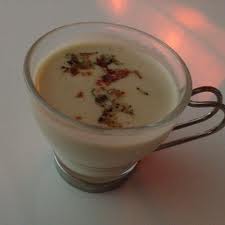
The appetizers we shared, of which there were at least half a dozen, were all to-die-for. My favorite was a hand rolled, black truffle, tagliatelle pasta. I don’t remember ever having tasted a truffle before, but it instantly became my favorite flavor in the world, reinforced by a serving of the chef’s signature dish, an espresso cup of white bean soup, scallions, black truffle oil and pancetta. The cup was too small to lick clean, but believe me, I tried.

marmalade bean soup

All the entrees were fabulous, judging by the fact that not a speck was left on anyone’s plate. And then came desert, which was served the way the appetizers were; there were many of them and we shared them all. It was the adult equivalent of being a kid in a candy store.

Ironically, the night before, we’d eaten at PK2, a Peruvian restaurant a few blocks from Ocean Park, where the experience was at the opposite end of the taste and service spectrum. We were greeted with the announcement that “the system was down,” and they could only take cash. We agreed that we would be able to pay for our meal the old-fashioned way, and then waited half an hour before the first entrée emerged from the kitchen. A few minutes later we had all been served—except for Hannah. Her uncle and I, the two diners closest to her, refrained from eating in solidarity and waited with her for another half hour. In the end, my dish was not only lukewarm, but way too salty, and hers was just blecch.

After we settled the bill, I demanded to know why my poor daughter had had to wait so long for her meal. The answer, in short, was that they’d run out of supplies and had to go buy more in order to complete her dish.

So that’s dining in Puerto Rico, from the sublime to the ridiculous.

Earring storage, practical and pretty

Earrings are one of my favorite forms of self-expression. They help me show off my silly, funky side, and they can be great conversation starters. I match my earrings to my mood, and sometimes to my outfit. When I was younger, I was particularly drawn to big, dangling earrings. Most of them were silver, to match the bangles I was also collecting. As I got older, I added more color to my collection and eventually even some gem stones.  I have a lot of earrings. In the beginning, it was difficult for me to keep track of them all.

My mother invented the perfect solution. She bought a flat, plastic box, with rows segmented into squares, probably intended to hold fishing tackle, and turned it into a jewelry box. She put a layer of foam in each square to raise the floor, and then cut pieces of felt to fit on top to give it a more finished look. Since the box was clear plastic, I could peruse my collection and choose the pair I wanted to wear before I opened it. To accommodate the larger earrings, she gave the same treatment to a box with a different layout, and when the original two boxes ran out of space, she made me yet another one. I loved those boxes.

moms jewelry boxes

Then I met Andrew. We’ve been married almost twenty years, and for most of that time he has been on the prowl for a “proper” jewelry box. My unique storage system never appealed to his more sophisticated aesthetic sense. However, he knew that convincing me to abandon my mother’s boxes would be difficult, and he was nervous about committing to a new one without my express approval. He continued to look and offer alternatives, but I never saw one that I liked more than what I already had.

This past birthday, Andrew stopped seeking my approval and presented me with a new jewelry box made by Heartwood Creations in Illinois. I readily acknowledged that it was a beautiful piece, but even so, I was stunned that he’d finally gone through with it, and I was secretly pleased to discover that the artful, handmade box presented a couple of unforeseen challenges. My bureau is tall, and with the box on top, I couldn’t see into the drawers. And although it was big, it was not big enough to hold my entire collection of earrings.

The first problem was easily solved; the new jewelry box would live on Andrew’s bureau, which is considerably lower than mine. The next problem was much more difficult. I had tried to cull my earring collection once before, but only got as far as moving some into yet another box and hiding it away under never-worn-lingerie. I forced myself to try again.

new jewelry box

Each day, I moved a few pairs of earrings into the new jewelry box, setting aside any that I knew I’d never wear again. I added those to the box that lived under the lingerie, until that box could hold no more, and still I squished them in. After a while, I began to appreciate how handsome the new jewelry box was, how grown-up it looked, and how much fun it was to open the drawers to choose my earrings for the day.

Full of resolve, I put all the earrings that were not making the move to the new box into a big, plastic bag and brought it down to the kitchen counter—where it still sits. But I assure you, it’s only a matter of time, because nothing dims nostalgia like the loss of counter space.

I’d miss you if I knew you were gone

When I was three, we drove from California where we had been living, to Massachusetts where my dad was going to begin his medical practice. The story goes that my parents had promised us that we could have a cat “when we saw a house we liked.” After a long stretch of not much of anything, somewhere in Texas, my older sister called excitedly, “There’s a house! Do you like it? Can we get a cat now?” Alas, we had to wait until my parents settled us in our own house in Lexington, MA.

Sugar, which my father claims was short for meshuga (Yiddish for crazy), was a big tiger cat. I don’t know how he got his name since I remember him as long-suffering, placid and forgiving. He was the only male in the family besides my dad, and he was the apple of Dad’s eye. My father kept a picture of his daughters on his office bookcase, frozen in time, faded by the sun, confusing patients who would occasionally send home knitted slippers and other homemade presents for his “little girls.” The framed photo of Sugar, however, hung in a place of pride on his office wall and never faded.

Then along came Alvin Wickersham, our parakeet. Alvin lived in a hanging bird-cage, like the one pictured below, so he wouldn’t be a constant temptation to Sugar. It didn’t work very well, and it kept Alvin too high to entertain little girls unless they climbed a chair to look in.

Bird-Cage

One day, after Sugar had managed to knock over the cage yet again, the door popped open and a terrified Alvin went zooming around the kitchen. In his panic, he hit his head on the wood valance over the kitchen sink. I have a vague memory of the poor little parakeet with blood on his head, but I may have painted the blood on in my mind. If he’d been a parrot, maybe we could have asked him questions like, “Who is the current president of the United States,” or, “What year is it?” to assess the damage. Lacking that diagnostic tool, my father made the best guess he could and declared Alvin not much the worse for wear, despite the bang on the head.

We three girls wandered off to continue living the life of little girls, torturing Sugar, and each other, and paying scant attention to our precious parakeet. Time passed, and I decided to check in with Alvin. I dragged the black, molded-plastic kitchen chair to the cage and clambered up to look inside. Alvin Wickersham was gone.

Before you blame my father for misdiagnosing Alvin, let me reassure you that for a people doctor, Dad made a pretty good vet. But that’s not really the point, because the fact is, I don’t know how much time passed between Alvin’s misadventure and his passing. It could have been days, weeks, or even months. The operative part of the story is that he was gone for several days before any of the sisters noticed.

Sugar probably noticed immediately, and may even have mourned the passing of his nemesis. I’m sure we girls were sad, too, for a while, until the birdcage was removed from the kitchen and then it was, again, out of sight, out of mind.

Sugar lived a good, long life. The day he died, we all cried, but no one more than Dad.

The best darn piano teacher in Arlington… VA

When Hannah was a little girl, we enrolled her in Keys for Kids, a group piano class. The program, created by a marvelous, innovative woman named Inga Magid, requires that each child be accompanied by a parent who sits with them at one of the electronic keyboards and works with them at home. For years, Andrew and Hannah participated in the program, moving through the entire curriculum from Mini Keys, to Kinder Keys to Super Keys. When Hannah began individual lessons with Miss Inga her enthusiasm waned. I suggested we get a new teacher and Andrew wailed, “But I love Miss Inga.”

“Then you should take lessons with her,” I replied. He did, and that’s a story for another time, but it left us without a piano teacher for Hannah. Then, in one of those rare coincidences that makes you believe in angels, I found a business card stuck in our screen door. On it was a picture of a piano with local contact information for a teacher of same. I called, and a few days later we met Candace Cleary.

Inga trained in the classical Russian tradition. She is an exuberant, out-going Latvian, who scolds and cajoles in equal parts. Candace is from Canada and got her music degree at a university there. I do not know what her own training was like, but she developed a teaching style that is warm and encouraging. She is gentle, and earnest, and soft-spoken.

Candace lived in the center of town, and taught in her apartment. At our first meeting she served us lemonade and cookies in her impeccably clean, simply decorated living room. She had us at hello.

New to the area, Candace was just beginning to build her clientele. Before long I had recommended her to my sister and a friend, each of whom brought two new students to her, and it wasn’t long before Candace had a schedule full of dedicated students, and grateful parents. She found music that appealed to each individual, teaching some popular music, others classical or jazz. Under her guidance, the students developed confidence as well as skill. She encouraged Hannah’s interest in improvisation and another student’s interest in composing. There was nothing cookie-cutter about Candace.

For years Hannah had been happily taking lessons from Candace and we were thrilled. Many kids give up on music once they enter high school, but here we were, in Hannah’s junior year, and she was still going strong. And then, Candace told us that her husband had gotten a job in Washington and they were moving to Arlington, VA. I was devastated, as we all were.

It was such a joy to introduce people who were searching for a piano teacher to Candace. I’m hoping that residents of Arlington, VA will google for “piano teacher, Arlington, VA” and find this blog post. It would give me great pleasure to help Candace find students in her new home. But she only needs one to get the ball rolling; after that word will spread fast because a good piano teacher is hard to find. And now the best darn piano teacher in Arlington is in Arlington, VA. You can contact her at candace_cleary@icloud.com.

I’m sure I speak for all of Candace Cleary’s former students and their families when I say, from the bottom of my heart, thank you.

Do you like my hat?

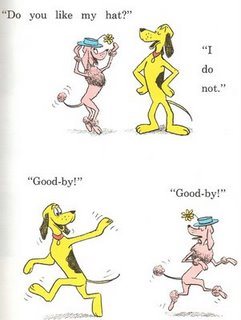
When my daughter was little, she spent at least a day a week at my parents’ house where the book Go, Dog. Go!, by P. D. Eastman, was a big hit, at least with my dad. “Do you like my hat?” is a recurring line in this charming easy reader. Dad loved to put on a ball cap and then say to Hannah, “Do you like my hat?” Then they would both giggle and recite the response, “I do not.”

do you like my hat

Hats were the subject of an exhibit that Andrew and I saw at the Peabody Essex Museum. The show was called, Hats: An Anthology by Stephen Jones. Stephen Jones is a contemporary British milliner and he designed many of the hats in the collection; hats worn by movie stars and royalty and other wealthy people. Other designers were represented as well, along with historical hats, like old-fashioned bonnets and caps, for perspective. Mostly, though, there were avant garde hats; hats made from metal, and plastic, and wood. There was a hat made of long strings of hair-like material that covered the entire body, like Cousin Itt from The Addams Family. They also had the helmet worn by Darth Vader. Perhaps that was a sop for all the poor husbands being dragged around the exhibit.

I love hats in theory, but not to wear, because when you wear a hat you invariably end up with the dreaded hat-head. In old movies, women had perfectly coiffed hair that didn’t appear the least bit mussed when they removed their hats. I’m guessing that their hair must have been thoroughly lacquered. I’ve never had a good enough hair day to be willing to cement it in place.

I did buy a hat once; I wrote about it three years ago in the post, Cocktails anyone? The woman who sold it to me insisted that I promise to wear it at least twice. I’m certain that I did, after all, I promised, but I can only remember one of the times. It was at a restaurant in Cambridge called Cuchi Cuchi, where the waitresses all wear little hats called fascinators. Technically, my hat is also a fascinator. Maybe that’s why I never wear it. I’m just not that fascinating.

Meanwhile, back at the exhibit, there was a fun, interactive display. You could sit down in front of a large screen and see what a selection of hats from the exhibit would look like on your own head.

judy_PEM_hat2

So now it’s my turn to ask, “Do you like my hat?”

Is writing about coming out still relevant?

Perfect is a book for young adults by Ellen Hopkins, a New York Times bestselling author who writes in verse. It’s the story of four high-school seniors, how they define perfection and what they are willing to do to achieve it. One of the characters, Cara, is in search of perfect love. She discovers it, to her surprise, with a girl.

My current WIP (work-in-progress) is a coming out story. The pitch for it might read like this: Emma’s façade of style and heterosexuality crumples when she hosts Maja, a gay Swedish girl, who makes Emma confront her decision to stay closeted out of fear – and her crush on her best friend Kaitlyn. There has been much discussion in my critique group and among my online writing community about whether or not coming out is still something teenagers struggle with. For every person who says, “That’s an important story to tell,” there is someone who says, “I don’t think it’s such a big deal anymore, certainly not around here.”

One of my writer friends, supportive of my contention that a story of a girl who is unwilling to risk friendships and social status by stepping outside the norm is still pertinent to today’s teens, suggested I read Perfect as proof that the topic is still timely.

I got a copy out of the library and set to reading. I was on page 107, where Cara meets the girl she will fall in love with, holding my breath for what I hoped would happen next, when I turned the page and was distracted by a small pamphlet that someone had left in the book. I finished the page, which ended with an electrifying kiss, and picked up the pamphlet.

The front showed a young person sitting on the ground, their head on their arms; the picture of dejection. The headline was, is there something missing in your life? My first thought was that a sad teenager had read the book last. Then I opened the pamphlet and realized it was a religious tract. I couldn’t read any further than, “If you do not know the Lord Jesus Christ on a personal basis, that is the problem.”

What an incredible coincidence, I thought. Someone left the tract at the exact place in the story where Cara kisses Dani. Then I thought, hold on, if it was a bookmark, did that mean whoever left it there never finished the book? And then it hit me. Someone left the tract there on purpose. Someone who disapproved of the character’s storyline and felt the need to make a statement left a “helpful” note for the next reader. A note that says, in part, “My friend, repent!”

I’m not that worried about my WIP’s relevance anymore. Apparently, there are still people who would make it difficult for a teenager to feel comfortable coming out—even around here.