Category Archives: Uncategorized

Short fiction

This week, short fiction for a change of pace.

*******

I was on the phone with my husband, Stanley, idly looking out the window while he debated with himself whether or not to buy a new video camera for our trip to Paris, when a banana peel came flying out of the green Jeep Cherokee parked across the street.

“Hey!” I interrupted him. “A woman in a car across the street just threw a banana peel out the window.”

“Go pick it up,” he said.

“While she’s sitting there? What if she has a gun?”

“Don’t be silly. Besides, why would she shoot you for picking up her garbage? Go get it and put it in the compost bin.”

“I’ll be totally exposed. What if she takes offense, or is annoyed, or just embarrassed? It could get ugly.”

“Take me with you. It’ll look like you’re absorbed in our conversation. When you get to the peel, you say, ‘Hang on,’ to me, pick it up and say, ‘I’ll throw this out for you,’ to her. It’ll seem totally casual.”

“Alright, I’m going downstairs. I’m on the porch, pretending to check the mailbox; nothing there. Now I’m on the front lawn. I’m walking across the lawn. This is so stupid; I can’t believe I’m doing it. I’m crossing the street.” The woman looked up as I neared the car. I reached down and straightened up with the banana peel held between the tips of my fingers. I said, with an edge, “I’ll throw this out.”

“Whatever,” she said, barely glancing at me. She was younger than I thought she would be, probably in her early twenties, and hard looking; too much makeup and a string of studs outlining her ear.

I couldn’t marshal anything appropriate to say, so I harrumphed without content and walked away. “I’m heading to the backyard,” I said to Stanley. “And I don’t have a bullet in my back so I guess this worked out okay.”

“Glad to hear it. So, like I was saying, this camera would be easy for you to use. It’s pretty much one-button operation so I think I’ll go ahead and get it.”

It was all the same to me. We both knew who was going to be using the camera. I dropped the peel in the compost bin. “Mission accomplished.”

“Look, I’ve got to get back to work.”

“You called me, remember?”

“Whatever.” That was what the woman in the Jeep had said. He hung up.

I walked back to the front of the house, holding the phone to my ear so it would look like we were still talking. Inside, I curled up on the sofa in the living room where I could keep an eye on the Jeep. I was still there when Stanley got home from work, and so was the girl in the Jeep.

Stanley parked his black Rav4 in front of the house, put his keys in his pocket, and crossed to the Jeep. I wondered what he could possibly have to say to her. A moment later, there was a loud noise and Stanley slumped to the ground. She had brought a gun after all. What a relief.

I waited for the Jeep to drive off and took some time to arrange my face. Then I picked up the phone and called the police.
Skids and a cop-out

It was early in the storm. The plows hadn’t been out yet. The ground was solidly white, but the snow seemed light enough to drive on. Besides, it’s New England; we can’t grind to a halt every time it snows. So I bundled up, hopped in the car, and backed out of the garage. I chose the flattest path out of my neighborhood, sensibly avoiding the hills down to Mass Ave., and drove slowly down the street. At the first corner, going slowly, I turned the car to the left and it slid to the right.

Steer into the skid sounds like a simple enough thing to do, but in the moment, who can? It’s so glaringly non-intuitive. Even more compelling is that steering into the skid doesn’t guarantee you won’t hit anything. If skids happened conveniently, the odds of successfully executing the prescribed maneuver would probably be quite high. If, for instance, you were on a track taking a defensive driving course, or you were the only car on the highway, in the middle lane. Most skids, however, are, by definition, inconvenient.

I regularly skid on local streets; narrow streets with cars parked on both sides, bordered by sidewalks peppered with trees. When I skid, my heart stops. In that terrifying moment when my car animates and develops a mind of its own, all I can think is “Shit!” I may instinctively steer into the skid, but I can’t say for sure. It’s over so fast and the relief is so palpable, there’s no room for anything else in my head.

At this point, I have to admit that this piece is screaming to be expanded into a metaphor for life. You see it, don’t you? But that would be so facile. If I did it, you would probably shake your head and say to yourself, “Really? She couldn’t dig deeper than that?” And yet, I’m so tempted I’m practically sitting on my hands to stop myself.

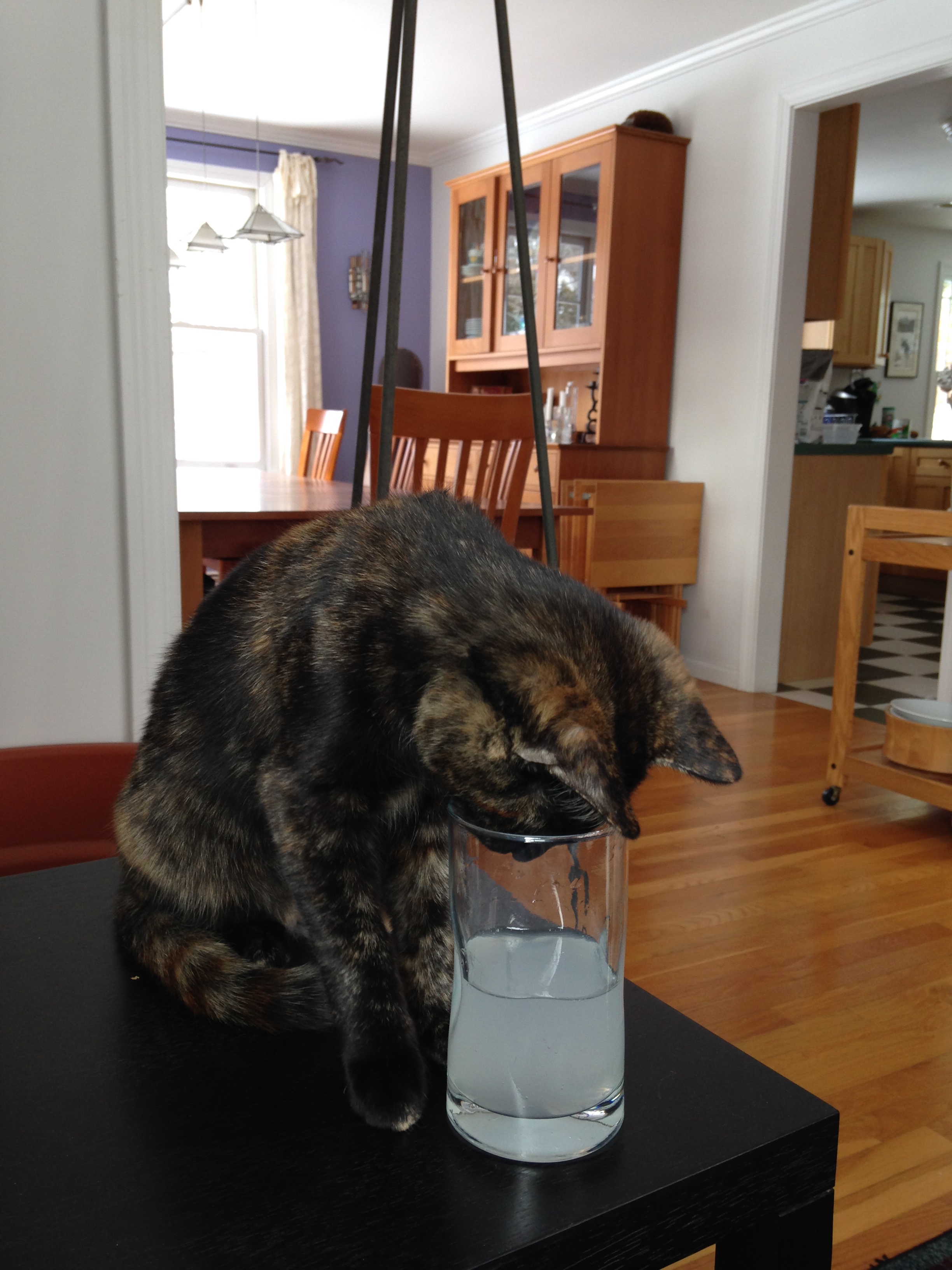
So now what? Remember the story I told about the person who posted a picture of a cat with a pancake on its head to interrupt a flurry of “reply all” emails that should have been sent as “reply” only? I’m feeling a little backed into a corner now and the only thing I can think to do is disarm you all with a similar pictorial non-sequitur. I give you Harper with her head in my Fresca.

harper in fresca

Birthday blues?

My birthday has me down. It’s not the age itself. As a matter of fact, there’s something appealing about the alliteration of fifty-five. It helps take the sting out of a number that it would be tough to argue is still middle-aged. No, this year, anticipating the number, which climbs inexorably every year, didn’t provoke anxiety or even mild teeth gnashing. The most I could muster was indifference, and that’s not like me.

I’ve always looked forward to my birthday, co-opting the date, December 25, as my own. I call it Judymas. Yes, I was born on Christmas. (When I say that, people ask, “Christmas day?” Yes, Christmas day, otherwise I would say Christmas Eve or the day after Christmas, or whatever.) It’s not the most convenient day to have a birthday. I’ve written about that before, so I’m sure you know the drill; no one to play with because everyone’s busy with their families, and thank goodness I like Chinese food because there are no other restaurants open. But despite the whole, “I’m Jewish and don’t celebrate Christmas,” thing, I do love the attention I get when people discover my birthday; that brief moment when I feel special. I don’t feel special any more.

Maybe I’m finally starting to grow up. I can no longer selfishly put myself above everything else that’s happening in the world to expect, nay demand, attention. Or maybe I’ve finally realized that I never was special. I generated my own PR and acted as a one-woman cheerleading squad. When I stopped cheering, things were strangely quiet.

I don’t want you to think that my husband and daughter failed me on my birthday. They didn’t. An appropriate fuss was made. There was breakfast in bed, with presents, and I got to pick the movie we went to that afternoon. My grousing is no reflection on them; it’s all about me (suggesting that maybe I haven’t overcome that selfish streak after all).

It’s commonly accepted that there are people who tend to get depressed around the holidays. Since the big one is Christmas, which I don’t celebrate, it doesn’t seem sporting of me to claim ‘holiday blues,’ but maybe that’s all it is. Yes, holidays and a touch of seasonal affective disorder—two sick parents, friends who are mourning, the loss of a beloved pet, disruption of personally satisfying pursuits—wait a second, I may be onto something here. That’s a lot of weight to have been carrying around (not to mention that I’m a stress eater and the last few months have been stressful so you know what that means). Could it be that on the run-up to my birthday I ran out of energy?

Yesterday my father had an encouraging doctor’s visit and we left feeling upbeat for the first time in a while. Our new kitten, Harper, is adorable (and we don’t really need a plant in the living room). Andrew likes his job and I’m confident that Hannah will go to college next year. Tonight we’ll be celebrating the New Year with friends. Objectively speaking, life could be worse. It seems obvious to me now; my New Year’s resolution will be to learn some new cheers, for me and you. Happy 2014.

It’s not the needle that hurts

Phlebotomy is a funny word. It’s probably because of the f sound at the beginning, like the word fart. If you mention that someone passed wind, people will look away discretely; toot might make someone giggle. But it takes the word fart to get a guffaw. Think how funny it would be if it was spelled phart! Phlebotomists, themselves, however, are not a particularly jolly bunch. As a matter of fact, I’ve met a few who are downright surly.

In preparation for an upcoming doctor’s appointment, I went to get some blood drawn. I knew the lab was closed for lunch from noon to twelve-thirty, so I arrived at 1:15. Taped to the door was one of those flat, representational clocks whose hands stay where you put them. It had the little hand pointing to the 1, and the big hand pointing to the 6. I was not pleased. I had a 2 o’clock appointment and was concerned about cutting it close. I was shifting from foot to foot, trying to decide what to do, when a delivery man carrying two small coolers came up.

“Not open, huh?”

I knocked, hoping the lab person would take pity on me. She opened the door, saw the guy, and said, “I thought that might be you.” He squeezed by and disappeared inside as the door closed in my face. By now, a couple more people had joined me in the hall and I was no longer the only one feeling growly. The door opened and the delivery guy squeezed out again. I threw myself on her mercy, “I have an appointment. Can you open up?”

“I get a half hour for lunch and I’m taking a half hour,” she snarled as she shut the door. There was clearly nothing to be gained by pointing out that she was late taking her lunch, thereby inconveniencing everyone else. I cut my losses and left, planning to return later that afternoon.

I gave myself almost an hour before my final appointment of the day. I figured even if there were a couple of people ahead of me, I’d still have time. As it turned out, there was only one, and she was already in the chair. I sat down feeling optimistic. For the next few minutes, it was strangely quiet. There was no chitchat, no nothing. Then I heard the phlebotomist say, “Still waiting.” That was not a good sign, and it only got worse.

The phlebotomist and her client were discussing how they could get the lab work done when the order hadn’t been submitted properly. There were options; they could call this one, or that one, or take the sample and send it elsewhere. Each option was discussed, weighed, rejected, and re-examined in light of all the other options. I thought my head would explode. After twenty minutes I left.

I needed to have the blood work done a week in advance of my doctor’s appointment. If the lab results didn’t get to him before I did, the visit would be pointless. I got home feeling as cranky as a phlebotomist forced to have a late lunch. Then I checked the calendar on the kitchen wall and saw that my doctor’s appointment was two weeks away, not one. I could start chasing the phlebotomist again the following Monday.

I got to the lab before they opened and was the first customer. I was relieved when a different phlebotomist opened the door and welcomed me in with a smile.

Then she said, “The computer’s down…”

Who adopts who?

Nadine was crying. She seemed desperate for attention, but when I approached, the volume increased. She shoved an arm through the bars of her cage, and then pushed her little snout through as well. It was harder to yowl that way, but she gave it her best shot. I reached out my hand and she pulled back her face and stuck her other arm through, grabbing one of my fingers with both paws. She might as well have been speaking English her plea was so clear. She must not have known that there was a small plastic card taped to the top of her cage that said someone is thinking about taking her home. On the other hand, maybe she knew that in an animal shelter the fat lady doesn’t sing until she’s walking out the door with her adoptee.

Our boy cat, Boo, had only been gone three weeks when Hannah and I dropped in at the Windham County Humane Society in Brattleboro, Vermont, on our way to celebrate Thanksgiving in West Wardsboro. We often visited the shelter, but with two cats of our own, we only stopped for a quick cuddle and then we were on our way. Now that Scout was the only cat at home, I knew we’d be tempted, but I thought we could risk a visit. After all, without Andrew we didn’t have a quorum. I didn’t count on Hannah falling in love.

We adopted Boo and Scout from the WCHS eight years ago, when Hannah was still a little girl. She was not happy about getting cats, but we assumed they would grow on her. Well, we underestimated Hannah’s powers of resistance. It took a very long time before she was comfortable with them; years. She did come to love them, however, and she was as bereft as we were when Boo died, but I never would have dreamed that she’d be the catalyst for our next pet.

It was late in the day, the day before Thanksgiving, and the shelter was winding down for the holiday. There were only a few kittens in residence and I didn’t pay much attention to them. I was more interested in the older cats. Hannah, however, zeroed right in on a kitten the shelter volunteers were calling ChaCha and it was love at first sight. There was no way we were going to be able to adopt that day; the shelter was closing and would not be open for the holiday. We knew, though, that if we wanted to adopt the kitten there was a good chance that she’d still be available—if we got there early enough—the day after Thanksgiving. Now all we had to do was talk Andrew into it.

Andrew took a little convincing. He felt it would be disrespectful to get another cat so quickly, even though he wanted Scout to have company. I didn’t entirely disagree, but Hannah’s excitement was hard to ignore. The case she built included her fear that if we waited until after she went to college to get another cat she’d feel as if she’d been replaced. (Better Boo than her, I suppose.) And she wanted a kitten, something small enough not to be intimidating. I was sold.

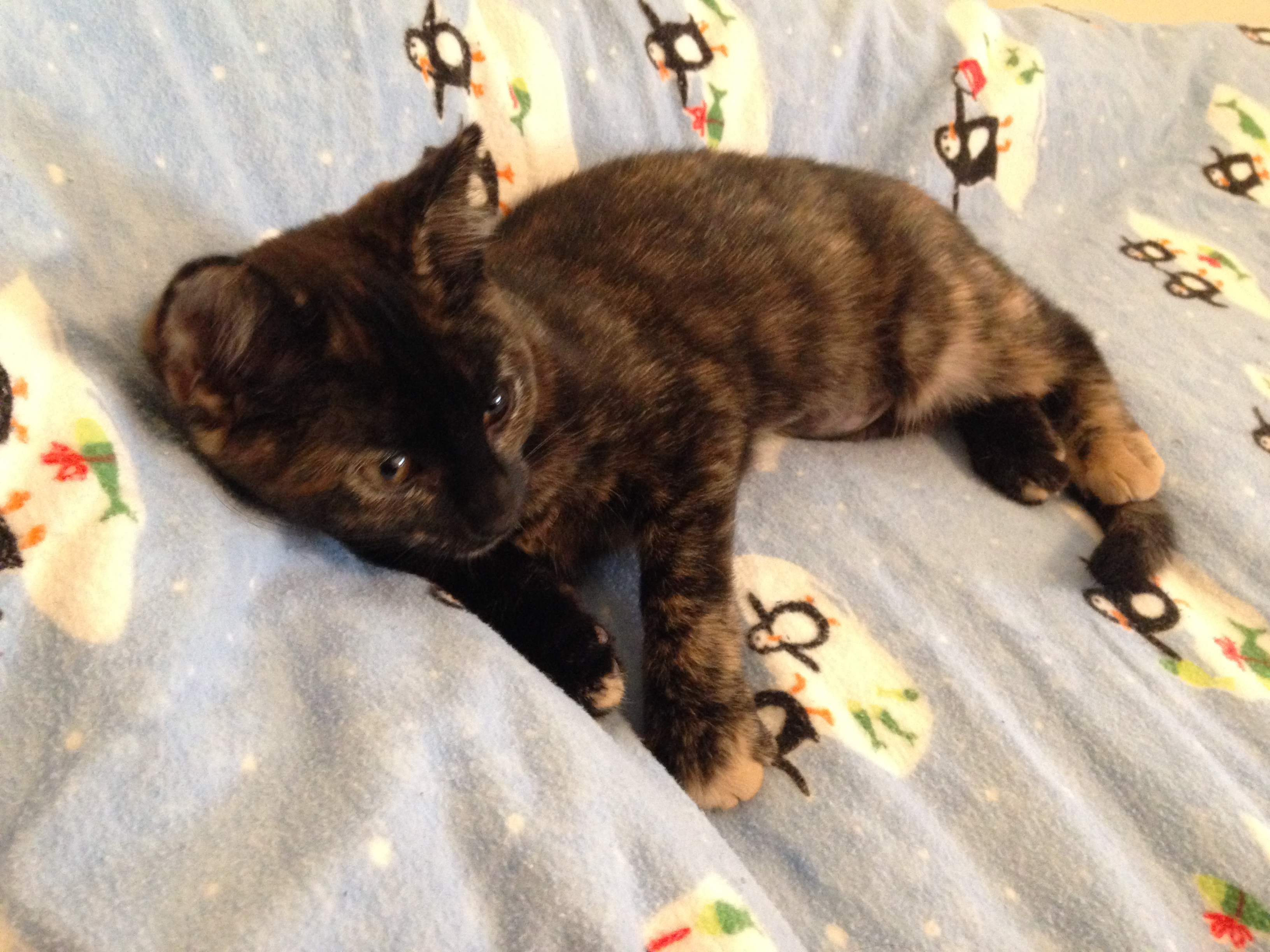
We told Andrew that he didn’t have to decide until he met the kitten. We knew she would close the deal, and indeed she did. So here she is, the newest member of our family, Harper.

harper at 3mnth

And it was a happy Thanksgiving for Nadine, too. She’s now in her forever home where I’m sure she’s making her new family very happy, just like Harper.

Short fiction

Something a little different this week, short fiction. Enjoy.

———————

The tips of my ears were chilled; soon the cold would seep inside. It was much harder to get rid of an earache than to warm up cartilage, so I dug my headband out of my jacket pocket. To put it on, I had to take off my gloves. I did it as fast as I could, without bothering to fuss with my hair. It was cold enough that anyone passing by would be moving fast. They’d barely have time to register my presence, much less scoff at my appearance. Even though it only took a moment, by the time I got my gloves back on I’d begun to lose the feeling in my pinky fingers. I picked up my rake and went back to work.

The wind swirled the leaves around, teasing them away from their piles, but not carrying them too far. I reached out with the rake to gather them back, and then hurried to stuff them into the bag before the next gust. The sky was turning grey, threatening snow. Today was the last yard waste pickup of the season. Whatever didn’t get bagged and dragged to the curb would spend the winter trapped under the snow and ice, waiting to mock me in the spring.

I felt a drop on my face. The precipitation seemed ambivalent; raindrops with snowflakes mixed in. I wanted the snow to prevail because it would take longer for the damp to make its way through my jacket; my gloves; my sneakers. It was strange to rake in the snow, but not unheard of. Some years the snow began before Halloween. It certainly wasn’t unusual to begin before Thanksgiving. But I couldn’t finish raking until the trees decided to let go of their leaves and it was hard to predict when that would happen.

It was impossible to get any raking done after work. It was dark by the time I got home. That left weekends, when all the other chores competed for my attention. As long as there were bagels in the freezer and toilet paper in the bathroom I could put off shopping. With enough clean underwear I could ignore laundry. And dust never bothered me. Honestly, there wasn’t much competition for my time, not since Lizzie went off to college, which was all Jack had been waiting for. He left right after she did, claiming he’d been unhappy for years.

My nose was dripping. I used the back of my glove to wipe the snot away. The glove was abrasive. I heard a truck shift gears and looked up. Down the street I could see the recycling truck turning a corner. They would work through my neighborhood, snaking down one street and up the next, until they came to my corner. At most, I had another half hour, which would barely make a dent in the piles I had not yet made. My face got wetter, but this time I knew what it was. Tears added the taste of salt to the white flakes of snow.

I couldn’t do this alone. I wasn’t supposed to be doing this alone. I hauled my last half-filled bag to the curb and returned the rake to the garage. Soon enough snow would bury the leaves and I would forget they were there. If only it could all be that easy.

Silence is elusive

I sit quietly, feeling contemplative. Slowly I become aware of the distant sound of traffic on the highway. Half a mile from my house, it is vague enough to escape my notice most of the time. During the day, when the neighbors are at work, my street is calm, but occasionally a car passes by and the disruption reminds me how grateful I am that the sounds of the highway are muffled.

Inside is calm; outside the wind gusts. The house reacts violently with sharp retorts; crackles and creaks that happen so fast I can’t identify from where they emanate. As the wind eases, the house settles and I can hear the remaining fall leaves rustle against each other as they strain to hang onto their branches.

The refrigerator clicks on and starts to thrum. I’m surprised. I thought it always ran, but when it stops again the silence is palpable. Except that it’s not silence; it’s only the absence of the sound the refrigerator makes. It’s a hole in the audible fabric.

My laptop, balanced on my crossed leg, hums. The white noise buffers my thoughts. Periodically the computer bleats to announce an email, or remind me that I’m supposed to be doing something else. When I’m working, the interruptions are jarring; unwelcome. If I’m distracted, they fuel my reluctance to return to work. Today, I am annoyed.

A gentle thump alerts me to the fact that the cat was somewhere she shouldn’t have been; the kitchen counter, a table. When I hear the thump it’s already too late to scold her. Besides, I didn’t actually witness her transgression. Maybe it was a poltergeist.

Across the house, our wall clock ticks. When I’m absorbed in my work I can’t hear it, but if I will myself to pay attention, to focus on my surroundings, the clock becomes intrusive. In film, there is something called rack focus. That is when the camera shifts focus from a subject in the foreground to one in the background or vice versa; one image is sharp, the other blurred. I wish there was a term for the audio equivalent.

I typically eschew solitude, equating it as I do with loneliness; quiet with despair. Ironically, I cannot work with music on, or the television. I can’t hear my inner voice if it has to compete with anyone else’s. Today, surrounded by sounds that I am not normally aware of, sounds that persist even when I am sitting quietly, I feel comforted. I am not alone: I am surrounded by the world. I am inspired by all the sounds of silence.

Butt in seat – now what?

The most oft-heard advice for would-be writers is, “Put your butt in the chair and do the work.” It sounds simple, doesn’t it? But what happens when you put your butt in the chair and your mind remains blank? NaNoWriMo (National Novel Writing Month) challenges writers to crank out 50,000 words during the month of November. I’ve written about this before, so rather than bore you with it again, I’ll just point you to that post so you can refresh your memory. Go ahead, I’ll wait.

When I wrote that post, three years ago, my imagination was all fired up and I was a writing machine. I’ve completed NaNoWriMo four times and each time I’ve emerged with content that I liked enough to continue working with it until it evolved into a passable manuscript. Last year, when NaNoWriMo rolled around, I was struggling to complete one of those manuscripts and my critique group convinced me that my time would be better spent finishing it, rather than creating yet another work-in-progress. I ended up frittering away the month and doing neither.

This year I was determined not to let November pass by without giving NaNoWriMo my best effort. It’s early days yet, but I’ve reached the conclusion that my best efforts are not going to be enough. I don’t have it in me. And when I say “it” I mean anything. During NaNoWriMo, if you’re stuck, you’re encouraged to type any words you can think up until you get your mojo back. No word source is forbidden; if you have to copy the phone book, go for it. I applaud that approach in concept and happily began the month without a plot in mind, instead, I captured my thoughts and feelings about what was going on in my life, whatever was top of mind at the moment I began to write. But it didn’t take long for me to lose my stomach for that exercise.

It’s not that there isn’t anything to say, quite the contrary. Life has been emotionally rich (not in a good way) and working overtime to provide me with great stories. My father’s been ill, my mom’s been ill, and at the same time, my boy cat, Boo, had to spend some time in the hospital. He came home and spent another few weeks with us before we finally put him to sleep a few days ago. Somewhere in there I had a fight with my sister. I apologized via email. She refused to accept my apology. (Tell me that that situation isn’t ripe with story potential.)

So you see, my problem is not a dearth of thoughts, or feelings, or events. My problem is that whatever inner mechanism turns those things into energy to run the creative engine is broken. I can put my butt in the seat, but I can’t do the work. Maybe when my parents’ situation stabilizes, and my daughter’s college applications are done, and I’m finished mourning the loss of my Boo-cat, the creative engine will kick back into gear.

boo on lap at hospital

Stained glass: not just for churches

Have you ever wondered why stained glass windows are called stained glass? According to Wikipedia, “…stained glass is glass that has been coloured by adding metallic salts during its manufacture.” And while stained glass windows were originally made from that glass, Wikipedia notes that “Modern vernacular usage has often extended the term “stained glass” to include domestic leadlight and objets d’art created from came glasswork [as] exemplified in the famous lamps of Louis Comfort Tiffany.” Rather than leave you scratching your heads, Wikipedia defines came glasswork as, “…the process of joining cut pieces of art glass through the use of came strips or foil into picturesque designs in a framework of soldered metal.”

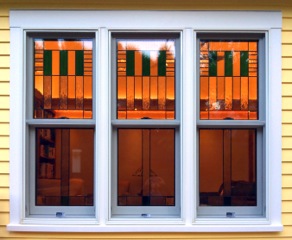
roger graf windows slant

No matter what you call it, I have always loved stained glass. When Hannah was born, Andrew presented me with a little Tiffany-style table lamp. It’s a beautiful thing, even if it doesn’t give off much in the way of light. And a few years ago, we splurged on art glass inserts from Andersen for two casement windows we added to our study. Andersen did not have many designs to choose from and the inserts were wildly expensive, but we assumed that commissioning the work would cost even more.

This year we made extensive modifications to our family room, including moving the door to the deck, adding three windows, and rebuilding the deck. Andrew redesigned the interior to include built-in bookcases and a stone surround for a new gas fireplace. We fantasized about adding art glass to the new windows, but discovered that Andersen didn’t make inserts for the double-hung windows we had ordered. And thank goodness for that, because then we met Roger Graf, the owner of Winchester Stained Glass.

Roger has a little shop, tucked away down an alley in the center of Winchester, MA. The shop sells small pieces that you can hang by a filament attached to a suction cup and an assortment of glass jewelry, but the real business is the work Roger does in the back of his shop. He repairs original stained glass art, matches existing pieces, and works on commissions. He’s a friendly man, always happy to have visitors to the shop, never seeming to mind the interruptions to his work. He will gladly take the time to discuss a project, even if you’re still at the stage where you’re simply speculating about the viability of it all. When we met Roger, Andrew had already come up with several possible designs.

The two of them discussed the design options and when they settled on one of Andrew’s designs, Roger took over. There are several types of glass in each window; colored glass is used sparingly; smaller pieces are beveled; alternating vertical bars are dense and corded; and the larger expanses have a subtle texture that makes you think you’re looking through water.

roger graf window single

Roger is such an artist that he cut the glass to fit around the hardware on the sash, and he installed the windows using cut-to-size horseshoe nails that blend into the came on the perimeter. His attention to detail spilled over into his billing practices as well; he is a scrupulously honest person.  If you’ve always wanted stained glass windows, but thought you couldn’t afford them, you should talk to Roger.

And if you want to see his work and I’m not home, you can always skulk around my back deck and admire the windows from the outside.

roger graf windows outside

Tanzania, albinos, and middle grade fiction

Our local public radio station was having one of its ubiquitous fund raisers, offering as an incentive a twelve-day photo safari in Tanzania. Each time they promoted the safari, I sat up a little straighter, not because I thought for a minute that I could be the lucky winner, but because I’d been meaning to write a Tanzania-related blog post and the constant reminders made me feel guilty. So, without further procrastination, here it is.

According to Wikipedia, although East Africa was handed over to the British after World War I, “In the late 19th century, Imperial Germany conquered the regions that are now Tanzania (minus Zanzibar) and incorporated them into German East Africa,” which might explain why there was a particular German doctor living there at the beginning of World War II. That doctor wanted to return to Europe and was willing to barter the medical practice they had in East Africa for property in Austria. And that’s how my mother-in-law came to spend a number of her childhood years in East Africa. It’s a fascinating story, but it’s hers to tell so I won’t go into it now. However, because of her story, I am particularly intrigued by all-things-Tanzania.

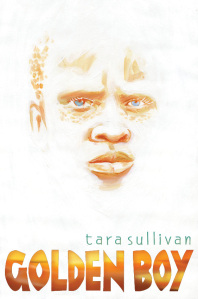
Tara Sullivan recently published her first Middle Grade novel, Golden Boy, about a thirteen-year-old albino in Tanzania, named Habo. His father abandoned the family after Habo’s birth. They are evicted from their home and forced to leave their village to go live with relatives in Mwanza. During a harrowing trip across the Serengeti, Habo learns that there are people who believe that albino body parts bring good luck, and that there is a market for those parts. After an encounter with an albino hunter in Mwanza, he fears for his safety and flees, making his way to Dar es Salaam where the rest of the story takes place.

goldenboy_cover

Golden Boy has gotten wonderful reviews. Kirkus described it as, “A riveting fictional snapshot of one Tanzanian boy who makes himself matter,” and gave it a starred review, which is considered high praise in the publishing industry. School Library Journal also starred their review, saying “Readers will be haunted by Habo’s voice as he seeks a place of dignity and respect in society. An important and affecting story.”

Tara knows about alienation and it is clear in her writing. She was born in Calcutta, to international aid workers, and lived in South America and the Caribbean before moving to Virginia at age fourteen. An ivory-skinned red-head, the bright sun of her childhood damaged Tara’s eyes and precipitated her family’s return to the US. Her experiences clearly inform Habo’s story and his voice, which carries all the wonder and pain that comes from being so different.

It’s interesting to note that while Habo’s plight sounds like a made-up horror story, it is not; albinos are hunted in Eastern Africa, and for some reason, the number of incidents is higher in Tanzania. You can read more about that at Tara’s web site. You can also learn how you can help albinos in Africa, from simply sending sunscreen, to supporting advocacy groups focused on human rights.

When Tanzania was East Africa, it served as a safe haven for my mother-in-law. After reading Golden Boy, you will wish the same for albinos who live there, as well as marginalized people everywhere.