Category Archives: Uncategorized

Short fiction; untitled

I wrote this in 2002, as an assignment for a writing class for a scene in which setting was of primary importance. I’ve always loved it, so I thought I’d share it with you here.

***

The sound of a neighbor’s lawn mower and the slight breeze from the open windows made it difficult to concentrate at the computer. Abandoning further attempts at productivity, Amelia rolled her chair away from the desk and went downstairs. She picked up her book and a rag to wipe the pollen off the rocking chair and went out the door. As she ran the rag lightly over the seat of the chair she grimaced, noting that the green paint was already starting to fade from the arms. She draped the rag over the rail of the porch and dragged the rocker to the far corner so she could be closer to the wisteria. Scott had planted the vine three years ago as little more than a shoot, and although it had already grown up the side and across the top of the farmer’s porch, the cascading blooms were concentrated near the few feet closest to the roots.

It was still early in May but the clematis vine, which Scott faithfully trimmed back every fall, had already woven itself thoroughly through the balustrade, providing the illusion of privacy.

Amelia opened her book and started to read. The sun made her eyes water and shading them with her hand didn’t help. Her attention wandered. She was distracted by several large bumblebees who were working in the wisteria. It wasn’t so much the noise they made, which was considerable, but a childlike anxiety that they would turn on her. She couldn’t remember whether or not bumblebees actually did sting people, but she was prepared to err on the side of caution. She glanced up at the ceiling. Scott had said there was a hole in the soffit that he’d seen hornets going in and out of, or maybe wasps, she hadn’t been paying attention. Whichever it was, she knew for sure that they were dangerous. Scott was going to spray something in the hole to kill them, but she didn’t know if he’d ever done that.

She contemplated moving her chair closer to the door, away from the bees and hornets, but a glance in that direction reminded her that she’d never watered the plant with the little purple flowers that was hanging from a hook in the ceiling near the stairs. She pushed herself angrily up from the chair, setting it rocking, and walked the length of the porch to the watering can that Scott insisted on keeping handy so he could minister to the garden whenever the spirit moved him. As Amelia reached down for the handle she saw her face reflected in the water. She watched as a tear made its way down the side of her nose and fell in, causing small ripples where previously all had been still. She watered the plant, despairing of ever learning what it was called now that Scott was gone.

The chair continued to rock after she’d gone in the door and back up to her computer.
Power-watching television

There is something very satisfying about power-watching a television series. For the uninitiated, power-watching is watching multiple episodes of the same show, back-to-back in a single sitting. When we started watching The Sopranos, there were four or five seasons available on disc from Netflix. Most of them had three episodes, but once in a while there would be four. That fourth episode was like the last piece of pizza in the box; you’re already stuffed, but one piece isn’t going to be enough for lunch the next day so you might as well go ahead and eat it. When the four-episode disk was over, we were so full we almost didn’t mind waiting a few days for the next one to arrive. Almost.

We’ve power-watched a number of series over the years including The Wire, Weeds, Big Love, In Treatment, Slings and Arrows, and Tell Me You Love Me. Some, like Prison Break, start strong, but begin to lose their appeal after a couple of seasons. I find it difficult, however, to stop watching a show I’ve power-watched for a season or more, particularly since Netflix introduced streaming.

Back in the day, we’d finish a disc, pop it in the mail, and wait for the next one to arrive. That enforced cooling-off period gave us time to reassess our addiction and, if necessary, take corrective action by moving the next disc in the series further down the queue in Netflix. If we did this more than a few times, we knew we were cooling on the series and on our way to breaking the habit. With streaming, each time you look at your “instant queue,” you see a list of all the episodes for the entire series. It is way too easy to say, “Let’s try one more. Just one more. I promise this will be the last one.” And yet, it never is. When the US Postal Service no longer intervened to slow our pace, I realized we, okay, I, had a problem.

In truth, this isn’t really a new problem, merely a variation on one I’ve always had—with books. I can count on one hand the number of books that I’ve abandoned before finishing them. I don’t know why I can’t toss them aside half-read. It’s not as if I’m afraid that as soon as I close the book for good, the one-dimensional characters will expand like an inverse pop-up book, or the plodding plot will suddenly break into a gallop. Honestly? It’s that I worry that it’s not the author’s fault, but mine; I’m not clever enough to appreciate their work.

I don’t have the same insecurity when it comes to judging television series. For instance, Netflix has a new original series called Hemlock Grove that I added to our instant queue. It’s horrible. According to Tim Surette of tv.com, “I’ve had acid flashbacks that made more sense than Hemlock Grove.” So why, then, have I watched half a dozen episodes? Because the whole season is listed on my instant queue and I keep thinking it might get better.

A simple intervention might set me straight. If someone were to delete Hemlock Grove from the queue, I’d probably fuss and fume for a bit, but then I’d move on—to a different series. Any suggestions?

A cure for smelly shoes?

My endodontist’s office is on Mass Ave, next door to a big old house that’s been divided into multiple apartments and across the street from a small strip mall with a realtor, a dry cleaner and a veterinarian. With the window blinds up, I am on display to anyone who drives by or looks up as they pass on the sidewalk. Much as I like company and eschew privacy, in this particular situation I would like less of the former and more of the latter. The upside to the arrangement is that if they can see me, I can see them, and the voyeur in me appreciates the quid pro quo.

On my last visit, to assess yet another tooth gone bad, I noticed a pair of sneakers in the upstairs window of an apartment in the house next door. They were arranged toe to heel on the sill. Even with the screen, they seemed precariously balanced, as if at any moment they could plummet to the ground, three stories below. I pointed them out to the assistant who was busy laying a lead apron on top of me. She followed my finger and said, “Goodness, why would they do that?” To air them out, although it is not something I’ve ever seen done around here.

Once, when I was young and carefree, I stayed at a fancy hotel in London while on a business trip. I entertained a gentleman caller one evening and when it was time for him to leave, I saw him retrieve his shoes from the roof outside the window. In truth, gentleman is a bit of a misnomer in this case. He was neither of good family, breeding, or social position nor was he sensitive, civilized, or educated—all dictionary definitions for gentleman. He was, however, in this particular instance, a well-mannered man. A scrapper from Notting Hill (before gentrification) by way of St. Vincent, he had never had occasion to be in a nice hotel, much less a posh one like the St. James’s on Park Place. He was clearly impressed and determined to treat it with respect. I didn’t see him remove his shoes or put them outside the window so I can’t say whether or not they needed airing out, but I appreciated the gesture nonetheless.

In more recent history, my mother-in-law took us to Paris for vacation, and we visited family friends at their apartment in St. Maur des Fosses. The friends, a Japanese woman and her French husband, live in a fifth floor walk-up with their youngest son. The apartment is quite small; their bed is a loft platform reached by a ladder with no railing, and the son’s room is barely big enough for a twin-size futon. In order to accommodate visitors, most often her parents from Japan, they purchased the apartment next door, which can be accessed through a door in their kitchen. While touring the empty apartment, I noticed several pairs of shoes lined up on the windowsill of an open window, with no screen to prevent them from taking flight.

My next visit to the endodontist is coming up soon. I am curious to see if the sneakers will still be there. And now I am even more curious about who owns them. Are they from another country; England, France, Japan, or St. Vincent? Or is the owner more pedestrian, a local teenager with stinky feet? Perhaps musing about that will distract me from my root canal. In any case, if you’re in the neighborhood during my appointment, please keep your eyes on your feet until you’ve passed by. Maybe, if you think you need to, it will remind you to put your shoes in the window when you get home. I’ve heard it helps.

Fielding balls in the backyard

Behind the house where I grew up was a tennis court. It belonged to a neighbor whose extensive property included several acres behind our house. We didn’t have much of a backyard; it abutted a low stone wall behind which was a standard, neighbor-separating wooden fence.  Towering above that fence was a practice backboard. Most of the year, weather permitting, we’d hear either the soft plop of tennis balls being hit back and forth on the clay court, or the bang, bang, bang, of a solo player practicing on the backboard.

Sometimes there’d be a “Darn!” and a ball would fly over the fence. Sometimes it would be the other way around. Then, from the kitchen window, we’d watch someone climb over the stone wall, drop into the yard, take a quick look around, scrabble through the pachysandra and hop back over the way they’d come.

If we were outside at the time, and heard or witnessed the event, we’d call, “Hang on,” and send the ball flying back over. However, there were times when we’d be out sun-bathing, or reading, or otherwise hanging out, and we’d be oblivious to the advent of the ball and surprised by the appearance of the tennis player. The surprise was often mutual and we’d watch the ball chaser’s visage change from slightly annoyed to hang-dog when they discovered that they were not alone in our yard either. I never minded these intrusions. In fact, I quite enjoyed them.

Some people guard their privacy. I am not one of them. As I write this I am sitting on my front porch, listening to the bees in the wisteria and keeping an eye on the world as it wanders by; willing it to wander by. If I’m lucky, someone will notice me and wave hello, or venture up to the porch for a chat. If I didn’t want to be bothered I’d stay in my office upstairs, or enjoy the weather on my back porch where, until recently, I would have had all the privacy anyone could want.

We have new neighbors on the far side of our backyard fence, a lovely young family with two small children. We’ve had several neighborly interactions with them and last weekend they invited us, via text message, to come to a barbecue to celebrate their little boy’s first birthday. Feeling a little awkward and shy, we ventured over. Most of the guests were visiting family members from New York and Pennsylvania, including an eight-year-old whose batting prowess was such that several balls had to be retrieved from other neighbor’s yards during the course of the party.

The next day, while I was sitting on my front porch, one of the out-of-town relatives and his eight-year-old appeared from behind my house and strolled down the side, looking for a lost ball. I was surprised, but not unhappily. I joined them in their search, even introduced them to another neighbor so we could look in their yard, too, but we couldn’t find it. Later, when I told my daughter this story, she said, “Oh, they found it.” She had just watched the new neighbor cross our backyard to retrieve it.

Now that I’ve shared this snippet of my life, it occurs to me that it’s less about the relative merits of privacy than it is an admission of how much I like company, no matter where it comes from, or how it gets here—as long as no windows are broken in the process.

Appealing for a curb

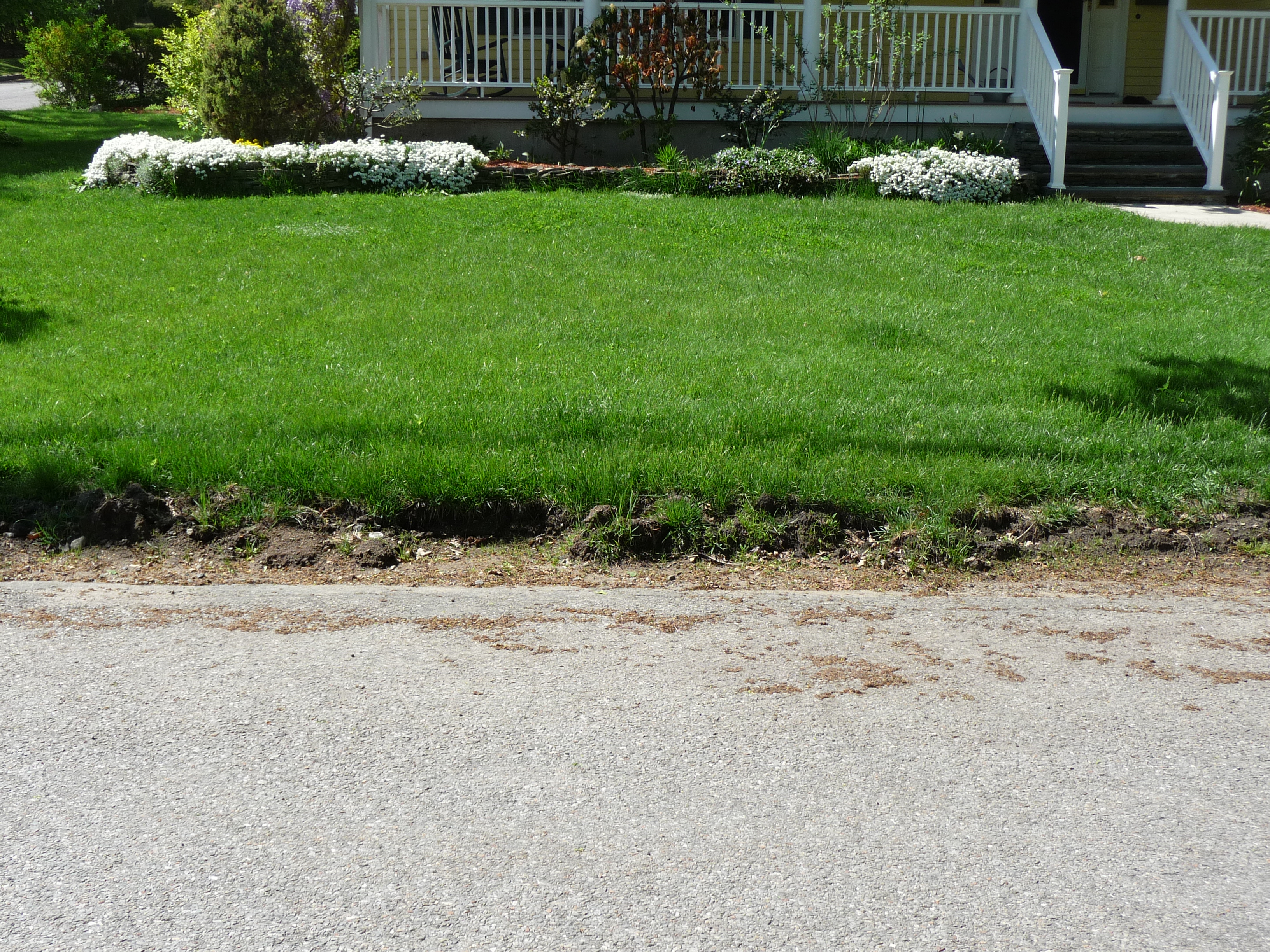
Every winter, the snow plows destroy the front edge of our lawn. Some years are worse than others. The damage this past winter was particularly egregious. Maybe that’s because this was the winter that my husband gave up trying to protect said lawn from said plows. In the past he’s planted white metal rods tipped with a bit of fluorescent paint, at the edge of the lawn to telegraph to the snow plow drivers that there was, indeed, a lawn under the snow. It worked, nominally, but there was still a mess to clean up every spring.

If it was just a question of re-seeding, Andrew might have hung in there, but even that turns into the project from hell once you factor in the need to water twice a day. And the reality is, re-seeding alone doesn’t do the trick, because instead of sloping gently down to meet the asphalt, there’s a shorn off strip of lawn that is several inches high. How do you plant grass seed on a vertical expanse?

Here’s a picture of this year’s mess.

P1030791

I decided enough was enough and called the town to ask them to put in a curb at our address. The Town Engineer told me that they would love to put in a curb—the next time road work was being done on my street. However, that work is scheduled three years in advance and my road is not on the plan, nor is it likely to get on the next three-year plan either.

“We’d be happy if you’d put in a curb yourself,” he said, “as long as you use one of our authorized contractors.”

Why would the town like me to put in a curb? Because then I would be beautifying their property. It seems that we don’t actually own the bit of lawn that meets the road. I’m not sure what the exact measurement of the easement is (I don’t even know if I’m using the word easement correctly), but I do know that the town insists that the curb be set much further back towards the house than where the lawn meets the road today.

This will not be an inexpensive job. Aside from putting in the curb itself, the road will have to be patched to connect it to the new curb. I asked the Town Engineer, “If we do it ourselves, will the town pay for putting down new road?”

“I doubt it,” he said. Really? I know we don’t own the road. If the town is dictating how the job must be done, doesn’t it seem fair that they put some skin in the game? I ask that knowing full well that they have us by the proverbial short you-know-whats. If we want to keep our property from being damaged annually by the snow plows, we need to put our money where their maws go.

We’ve arranged to have the work done and I’ll be dogging the contractor every step of the way to make sure we don’t give up one iota of lawn that we don’t absolutely have to, and in the end, I’m sure it will be a massive improvement over what you see above. Our pretty property deserves a more appealing curb.

P1030789

But I’m going to ask the contractor to bill separately for the road work so I can continue the discussion with the town. I know times are tough, and the town doesn’t have spare money, but there’s a principle at stake here. If this is something they’d pay for if they were working in the neighborhood, don’t you think they should reimburse us? Please let me know before I make a fool of myself tilting at a windmill.

My nemesis, the dandelion

Each year, in the spring, a day arrives when I realize I cannot wait one more minute to replace the storm door with a screen. I act spontaneously, forgetting that it will trigger an emotional domino effect that will drive me to put in all the screens—which can’t be done until the windows are washed. If I stopped to count the windows I’d have to take a nap before I began, so instead I treat each room as a discrete project. I retrieve the screens from the basement, wipe off the windowsills, wash the windows (inside and out), and finally, put up the screens. In this fashion, one by one, each room is readied for the new season.

Once the windows have been dealt with, I turn my attention to the yard. Andrew is the gardener. It is entirely thanks to him that we have such lovely landscaping. Other than mowing, I have only one more lawn-related job that generally begins after the forsythia bloom and the windows have been washed; dandelion removal.

Despite the fact that we have lovely gardens, the lawn itself is not in very good shape. There is an awful lot growing that can’t be called grass no matter how you stretch the definition. Given the woeful state of the lawn, one might find it a bit odd that I’m compelled to root out dandelions while ignoring other weed-like things. But it’s not odd at all. I do it because (to mangle an Arabic proverb) the enemy of my father is my enemy.

My father is a skilled and dedicated dandelion hunter. He goes after them with a vengeance and even though he tsk-tsks each time he sees one, the gleam in his eye belies his dismay. For a man who is constantly at war with crab grass and chinch bugs, dandelions offer him some respite, because he knows he can defeat them. When I was old enough to help, he taught me how to pry them out of the ground without destroying the lawn. If I pulled one up and left the root behind he would shake his head and I felt the weight of his disapproval.

You have to be vigilant to rid a lawn of dandelions. It is imperative that you get rid of them before their bright yellow flowers turn into puffballs of doom. The first foray into the yard to hunt dandelions is exhausting. No matter how good a job I did the year before, dozens of them pop up each spring. And while the initial pass is satisfying, it is always a disappointing surprise to look out the window the next day to see more of the bright yellow flowers dotting the lawn. Over the course of a week or two, though, the job is mostly done. I know that for the next few weeks I’ll spot one or two as I’m mowing, but they’ll be easily dispatched.

It is our misfortune that my father’s lawn never suffered from a mushroom problem. They are ugly, vaguely disgusting things without even a pretty color to redeem them. Andrew has studied the problem a bit, but has not yet found a way to defeat them. When mushroom season arrives, I do my best to ignore them. After all, my work is done. The dandelions are gone.

How to get rid of old gasoline, the hard way

Every other year or so we take the lawn mower to a local business, A. W. Brown, to it have cleaned and the blades sharpened. They remind us that it’s important to run the engine completely dry at the end of the season and not to use the leftover gas the following spring. The same rule applies to snow blowers. So what is one supposed to do with the leftover gas? Put it in the car’s gas tank, says A. W.

It sounds counter-intuitive to me to put old gas in a $25,000 car and not in a $500 lawn mower.  I brought this up at the gas station yesterday and some guy said it was because the car’s gas tank is so much bigger it can absorb the impurities in the old gas more easily than the little gas tanks can. That made sense to me, but what do I know? More to the point, what does he know? This wasn’t the service station guy, just someone getting gas for his own lawn mower. But I trust A. W. Brown and he said that’s what we should do so that’s what we were going to do—for the first time in the sixteen years he’s been telling us that. Maybe if we’d followed his advice earlier we wouldn’t be such regular customers.

I pump my own gas and I love the way it smells, so pouring gas from a can into a car seemed like a simple enough project for me to manage, but I quickly discovered that it required more than two hands. The first problem was that our two-gallon plastic gas can (which clearly can’t be a can if it’s plastic, but you get the idea) was awkward to manage with one hand. But even if I could have, the funnel that we use to get gas into the lawn mower was too short to push open the metal flap that covers the opening where the gas goes into the car.

plastic funnel

To do that, we needed to stick something through the funnel. I had just the thing. Before I’d gotten distracted by what was meant to be a five minute project emptying old gas into the car, I’d been uprooting dandelions with this:

dandelion tool

Even with four hands and the clever application of a tool for something other than its intended purpose, we weren’t quite there. We needed a smaller container for gas; something I could hold with one hand. A quick trip to the basement turned up another, smaller, funnel and a plastic bottle that we were willing to sacrifice to the project.  Thus armed, we returned to the strip of lawn that runs alongside our driveway to attempt transfer number one. Andrew held the smaller funnel in the bottle while I poured gas into it. I got some on my hands and some on the lawn, but mostly it went into the bottle.

Next, Andrew put the original funnel into the car and inserted the dandelion tool through it to push the flap open. I then poured the contents of the small plastic bottle into the funnel. It worked. Elated, we did it again, and again, and a few more agains, until both our good spirits and the gas can were drained. Then it was off to the gas station to refill the can so the cycle could begin again.

Today’s errand? A trip to the hardware store for one of these:

gas can with spout

Welcome to spring!

Putting the ‘care’ in foster care

Imagine how scary it must be for kids in the foster system, to be taken away from parents and siblings and handed over to strangers. Those kids need all the help they can get.

The Nina Foundation, whose original charter was to raise money for Rhode Island kids in need, was established in 2003 by children’s author Erin Dionne and her family to honor her grandmother’s memory. The foundation partnered with the Rhode Island Department of Children, Youth and Families (DCYF) to provide “…the financial assistance, furnishings and necessities needed to help…families create a safe and healthy environment for their children.” After doing that successfully for a decade, this remarkable family went even further. They bought a house, fixed it up, and donated it to a program called Families Together, run by the Providence Children’s Museum in concert with the RI DCYF.

Children in foster care are typically removed from their families because of neglect or abuse. The long-term goal of the system is to improve the family’s situation and put it back together again. The state provides training and support for parenting skills and supervises meetings. From the museum’s website, “Families Together offers a variety of visitation services.  With the support and guidance of the Museum’s family therapists, parents engage in healthy play activities with their children where they improve communication and parenting skills.”

NinasHouse

Nina’s House expands this program by providing a home setting where parents can work on normal, everyday skills while visiting with their children. They can make a meal, give their child a bath, or just read them a book. Sometimes it’s the simplest things that make the biggest difference.

Did you know that foster children often have to drag their belongings from placement to placement in plastic garbage bags? When I first heard that I resolved to donate some gently used suitcases to kids in foster care. I went online to mass.gov to poke around and found a Department of Children & Families site that had information about volunteering and donating, but no mention of the need for suitcases. A subsequent search for foster children suitcases turned up an organization called Suitcases4Kids, but there was no drop-off point in Massachusetts. Frustrated and disappointed, I ended up donating the suitcases to a local organization that worked with the Lost Boys from Sudan who were also in need of suitcases.

Thinking about kids in foster care breaks my heart, and yet, I’m not eager to sign up to become a foster parent. I was not the sort of mother who volunteered to lead a Girl Scout troop or chaperone fifth grade science camp. I don’t think I’d make a very good foster parent, and heaven knows these kids have enough problems already. But when I hear of an opportunity to do something to make their lives a little easier, I do what I can. Now that I’m out of suitcases, Suitcases4Kids has added a drop-off point in Needham. They also list sites in Maryland, Hawaii and New Hampshire. If you have old suitcases, please consider donating them.

The grandmother who inspired Nina’s House used to say, “A little kindness never hurt anyone, ya know!” She was so right. We can’t all donate houses, but the kids in foster care can use all the kindness we’ve got, and a few suitcases, too.

Fact or Fictionary?

The Boston Globe reported that the rules for the annual Scripps National Spelling Bee are changing. Starting this year, contestants will not only have to spell words, they’ll also have to take a multiple choice vocabulary test. As reported, the sample provided by the Spelling Bee was:

“Something described as refulgent is: a) tending to move toward one point, b) demanding immediate action, c) rising from an inferior state, d) giving out a bright light.”

Much to my surprise, I knew the answer! Not because I’m well-read and had a good liberal arts education, no. I owe my fleeting sense of erudition to Fictionary, a game for everyone who cringes when someone suggests charades.

The rules are simple. You take turns flipping through a dictionary to choose a word that you are fairly certain none of the other players will know. (If you are playing with my friend Josiah, this part of the game can take a while because he knows a lot of words.) When you find one that will challenge the vocabulary of the other players, you copy down the real definition while everyone else writes down a mock one. Then you read all the definitions out loud and people vote for the one they think is right. When someone votes for a fake definition, the author gets a point.

In order to make a definition more convincing, players will try to mimic the style of the dictionary resulting in definitions that start, “Of, or pertaining to…” and may include phrases like “commonly found in” or “as of.” I have a hard time keeping a straight face when it’s my turn to read the definitions, sometimes I get downright hysterical.

During the game where I learned the meaning of refulgent, I was also introduced to the word jerboa, a small rodent that jumps. Strangely, that word is missing from the 1994 Merriam-Webster that I keep on my desk, so to verify that I remembered correctly I had to consult dictionary.com, which says that a jerboa is “any of various mouse-like rodents of North Africa and Asia, as of the genera Jaculus and Dipus, with long hind legs used for jumping.” That would make a great Fictionary definition if it weren’t true.

I don’t know why anyone would choose to play charades if there’s a dictionary handy. I’ve played with kids as young as ten and for some reason they make surprisingly good competitors. And they’re as likely to vote for the real definition as anyone. Try it yourself. What did you choose as the correct definition for refulgent? If you don’t know, grab a dictionary and find out. I’m not telling you the answer. I want to feel like a winner for just a little while longer.

What would Heloise say?

My local Stop & Shop hasn’t had small boxes of matches on the shelf for quite some time and I’m starting to worry. Those little boxes play an important role in my life and it’s hard for me to imagine how I’d get along without them.

Big boxes of matches, called kitchen matches, are still relatively easy to find, although the strike anywhere variety are a tad more of a challenge. Hannah needed three (matches, not boxes) for her survival weekend; we found them at REI. (We have two hundred ninety-seven left if you need a few.)

Fireplace matches, those excessively long matches that snap in half when you try to light them, are also easy to find; impossible to use, but easy to find. Our Weber gas grill, which is probably five or six years old, eats ignition systems. Since it’s still digesting the last one, to light the grill we turn on the gas and then poke a lit match into a convenient hole built into the hull of the grill for just that purpose. See, ignition systems are what you call an after sale partThe manufacturer expects them to break so they can sell replacement parts, over and over to those dumb enough to fall for it. Fool me once, shame on me, fool me twice, Andrew does the grilling.

If all you want to do is make fire, there are any number of gizmos that let you push a button or thumb a wheel to produce a flame. But when it comes to those small boxes of matches, fire is not what we’re after. We want the smell that you get when you strike the match, the odor that lingers when you blow it out, because sulfur is the best room deodorizer in the world.  Ask Heloise. I bet she’ll back me up. You can keep your Lysol and your Air Wick. In this house we believe in the power of matches. Every bathroom has its own box and we all know how to use them.

You’re probably wondering why we don’t use the leftover strike anywhere kitchen matches. They would certainly work, and even for us two hundred ninety-seven matches would last a while, but the box itself is not portable, which is to say, it won’t fit in my toiletry kit any better than a can of Febreze would. And that’s where real disaster threatens.

The cost of attending writers’ conferences adds up, so to save money I normally share a room, sometimes with a complete stranger. I’m sure you automatically assume that I’m worried about offending my roommate, and while that is true, I am equally worried about said roommate offending me. Never is the odor-masking power of sulfur more welcome than when sharing close quarters with a stranger.

I wouldn’t be doing this subject complete justice without airing a little more of my family’s dirty laundry. Considering the subject we’re on, it can hardly get worse, right? My husband and I have an on-going argument about what actually produces the odor cover, striking the match or blowing it out. He maintains it’s the former; I argue the latter. And now, as Mike Myers would say on Coffee Talk, “Discuss!”