Category Archives: Uncategorized

Sometimes you remember, sometimes you forget

1995 was a long time ago, before my daughter was born. It’s remarkable only as the year I had a miscarriage, which isn’t a small thing, but turned out to be a very good thing. I hadn’t really come to terms with the idea of having a baby when I got pregnant the first time, so I was more than a little conflicted about the news. I confess that I was ultimately relieved when the drama of the situation was resolved, and a few months later, when I found out I was pregnant again, I was thrilled. I rarely think about the miscarriage. It moved into the past and became a memory, like so many other things that happen in our lives.

Lately, I’ve been indulging in one of my favorite pastimes, throwing things out at my mother’s house. I’m not being cruel; my parents are fully on board. We pick a cabinet, or a drawer, and go through it, tossing out old bank statements and assorted papers from decades long past. Mom bought a shredder to help with the paper purging and it’s been a boon to our efforts. Unfortunately, you can’t shred frozen food.

When we decided to clean out the freezer, we ended up with two huge plastic bags for the garbage. It was astonishing to see how much that freezer could hold. In my house, we have a traditional refrigerator with a small freezer compartment on the top. Mom’s refrigerator has side-by-side doors and the left side is all freezer. We started at the top shelf where the ice cream and dessert things live. Ice cream gets turned around fairly quickly in their house, but the cookie dough she had purchased to support a high school soccer team several years ago had to go.

The next shelf had frozen vegetables; most of which went the way of the cookie dough. The freezer is so deep that it’s hard to tell what’s in it. I don’t blame her for thinking she needed peas—every time she went to the supermarket. Once something was put in front of the most recent bag of peas, like whole cranberries for a Thanksgiving project that never came to fruition, it receded from memory. Really, I understand how that happens. It was the next shelf that was truly fascinating.

The first package of meat I pulled out was steak from 2010. I was shocked. My mother, slightly embarrassed, argued that it was probably still good, because after all, it had been frozen. I disagreed and out it went. Next up was hamburger meat from 2005. She allowed as how that was, perhaps, a bit over the line and didn’t argue when I tossed it. Next up was chicken dated 1998. By now we had moved on from shock and awe to gleeful laughter. But we weren’t done yet. The pièce de résistance was a whole chicken from—1995.

That whole, frozen, chicken was older than my now seventeen-year-old daughter. And she’s not the only thing that came into our lives after that chicken. My sister produced another grandchild; we bought a new house; presidents came and went. The world turned and things happened; good things and bad things, funny things and sad things. And most of them are now distant memories. Our family has been under a lot of stress recently. We look forward to the day when our memories of this time will dim. In the meantime, that chicken provided us with a much needed laugh; a funny memory we’ll be happy to keep alive.

Now it’s time to go shopping, again. This time, Mom really does need peas.

Entitled to doesn’t mean approved for

A wonderful comedian, Steven Wright, has a bit that goes something like this:

I went to Store 24, but it was closed. The next day I went in and complained to the manager, “You’re supposed to be open 24 hours!” He said, “Yeah, but not in a row.”

Dealing with my father’s recent illness has been a little like that. It started in the hospital when the neurologist in charge of my father’s case, an expert in the illness he had, wanted Dad discharged to New England Rehab where he could get several hours of physical therapy a day and care commensurate with the seriousness of his illness. Doctor Bigshot, who oversees expenses for my father’s primary care provider’s practice said no. We don’t know if the primary care doctor was even consulted; Doctor Bigshot is in charge of the purse strings. When the neurologist heard he was incensed and instructed the hospital social worker to resubmit the request. He was determined to have Dad sent to New England Rehab. Twenty-four hours later, the transfer request was turned down again, by Doctor Bigshot. He wanted Dad sent to a “skilled nursing facility” which would be less expensive, and he was willing to have insurance pay for Dad to spend more days in the hospital while we argued with him.

This time, we (the family) filed a complaint with the insurance company. If the neurologist wanted Dad sent to rehab, then by golly that’s where we wanted him to go, too. After review by one of their own doctors, the insurance company agreed to authorize rehab. Doctor Bigshot overrode the insurance company. The neurologist, who had sworn to fight the good fight on Dad’s behalf, caved. He agreed to release Dad to a nursing home if he was guaranteed at least two hours of physical therapy a day.

Off Dad went to the nursing facility where, as bad luck would have it, Doctor Bigshot himself was in charge of the purse strings. After a month there, even though Doctor Bigshot and the insurance company agreed that Dad needed twenty-four/seven assistance, that he wasn’t strong enough to do much of anything on his own, they decided it was time for Dad to go home. We considered contesting the decision, but we weren’t convinced that the care he was getting couldn’t be duplicated at home, particularly because, according to his insurance, he was entitled to thirty-five hours of home care each week. And once out of the nursing facility we would no longer be subject to Doctor Bigshot’s penchant for parsimony.

We traded Doctor Bigshot for a VNA-like organization that would be responsible for his care at home. We told everyone that we spoke to that we wanted as many home services as we could get, that “Dad’s insurance entitles him to thirty-five hours of home care each week.” It soon became apparent that entitled to wasn’t the same as getting. Each discipline, Physical Therapy, Occupational Therapy and Nursing, would do their own assessment and recommend the appropriate number of visits per week. They explained that their goal was to teach the family how to provide the services to the patient. It only took us a few days to realize that we’d need a whole lot more help than was going to be covered by insurance, even if we could squeeze thirty-five hours a week out of them, which we couldn’t.

If educated people with resources can be brought low by the insanity of our healthcare system, I fear for us all. I have now put healthcare at the top of my list of requirements for any politician who wants my vote. I suggest you do the same.

Keep on keepin’ on

While my father is serving a stint at a skilled nursing facility (their definition, not mine) I am managing the occasional business that my mother either can’t, or doesn’t want to. For instance, Dad’s car was due for inspection and he was adamant that it be done before the month was over. In the past, I’ve missed my own car’s inspection date by several months so I know for a fact that the inspection stations don’t care. They slap on a sticker and you’re good for a year from the date of that visit, which means you’ve effectively bought yourself a few extra inspected months. What inspection stations do seem to care about is rust.

My father drives a 1988 Chevy Celebrity wagon. When a car hits twenty-five years old it is considered an antique and if you have a nifty ride that you want to draw attention to, like a ’65 Mustang or a ’61 Corvette, you can get a special, antique car, license plate. Most people with antique cars are enthusiasts who have worked hard to keep their rides in mint condition. My father is not one of them.

61 corvette

My dad’s car looks every inch its age, inside and out, but it keeps chugging along – just like him. The first inspection station I took it to, a young guy looked it over and suggested I not bother having them inspect it because the rust made it a non-starter (figuratively speaking). The kid explained to me that whoever is in charge of regulating inspection stations have taken to cruising around mall parking lots to look for cars with lots of rust. When they find one, they check the inspection sticker to see who passed the car and then they go shut them down for thirty days. This particular station wasn’t going to risk that. Grateful that I wasn’t going to be driving around with a failed sticker on the car, I pondered my next move.

I drove away, not sure where I was going, and found myself in front of the garage that my dad took his car to for repairs. I decided to stop in for advice. The very nice mechanic validated the story about inspection stations’ new-found sensitivity to rust, but commented that he sees lots of cars on the road that are in worse shape than my dad’s so, “Somebody’s givin’ out stickers.” He directed me to a likely station and sent me on my way with best wishes for my dad.

Primed for trouble, I arrived at my next stop. Rather than pull into a bay at the garage, I parked alongside and went in to confer with the mechanic. I told him I was worried that the car might not pass. He walked out with me and stared at the car.

“Because of the rust?” he said.

My grimace was my assent.

“I’ve seen worse. I can buy you a year. Long as it runs.”

I tossed him the keys and not ten minutes later I was on my way with a street-legal, 1988 Chevy Celebrity wagon.

I decided to hang onto the car for a few weeks. Dad doesn’t need it yet and I thought my daughter might like to have a car until school starts again. She did, mine. His she refuses to get into, much less drive. I don’t care. It is an ugly old thing, and the brakes are soft and the gas pedal sticks, but it’s still rolling along. And it’s not forever, because I know that when the time comes, Dad will want his old friend back.

The family needs Critical Care, too

After our exciting adventure to find St. Elizabeth’s, my father was admitted to the Critical Care Unit (CCU). In the CCU, the ratio of nurses to patients is much higher than on a medical ward and constant monitoring is the norm. Having Dad in a bed in the CCU was both comforting and distressing. His suspected (and subsequently confirmed) ailment was a progressive syndrome that, unchecked, could shut down critical systems, so close scrutiny was in order, but from his curtained cubicle I could hear someone imploring, “Wake up, dad, please, you have to wake up.”

When my father was wheeled off for a test at 10:30am the next morning, I was ushered out of his cubicle and into the waiting room for families of CCU patients. The room was large, with chairs and loveseats ringing the perimeter. High on one wall was an over-sized, flat-screen television. The volume was up, but the only other occupant of the room was engrossed in her iPhone.

“Do you mind?” I asked as I walked over and reached up to turn the volume down.

She looked up briefly and responded listlessly, “No.”

In silence we shared the room, until her three siblings came in and began to confer about their father’s situation. Champion eavesdropper that I am, I was actually trying not to listen, but it was difficult to tune out their conversation. I surmised that their father had been brought in with difficulty breathing and was now in a coma. I regretted, for their sake, that I had turned off the TV.

Later that day, finding myself alone again with the original woman, I asked for advice on parking at St. E’s. We started to talk and share our stories. Then I began to suffer a version of “survivor’s guilt.” I had been assured that my father would make a complete recovery, and my new friend was being told that her father’s prognosis was uncertain at best.

The next day, the siblings were distraught. They had had a tough morning with a nurse who had been brusque and discouraging about their father.

“Don’t lose hope,” I said. “There are plenty of things that medical science hasn’t figured out yet. He could wake up any time. They just don’t know.”  I spoke with as much authority as I could muster given that I didn’t have a clue what science had or had not figured out. I just wanted them to feel better.

I went on, “I’ve heard that doctors don’t really know if a person in a coma can hear. I think you should assume he can; play his favorite music for him, talk to him. Tell him what’s going on in your lives, share memories of special times with him. If he can hear, maybe it will help coax him back, and if he can’t, you might feel better for having shared with him how much he’s meant to you and how much you love him.”

I fought to keep my voice from breaking while I was talking to them, surprised by the force of my emotion. I was directing my comments to the siblings, but I was talking to myself.

Not long after that conversation, while I was in my father’s cubicle, I heard the sisters talking to their father. They were telling him stories and playing Frank Sinatra music. I know it helped them. I hope it helped him.

My advice? Take an ambulance.

No sooner had my vertigo abated than my mother called to say that Dad’s doctor wanted him admitted to St. Elizabeth’s, a hospital in Brighton that is home to a doctor who is an expert in the illness the original doctor suspected. Dad didn’t want to go by ambulance, and Mom wanted help navigating, so she said she would swing by to pick me up. While I waited, I typed the address for the hospital into my GPS and asked it to simulate the route so that I would have an idea of where we were going. In a strange, prescient move, I was starting to copy the directions onto a piece of paper when my parents arrived. I jumped into the backseat and we headed for the highway.

“Here,” I said, leaning over the front seat, “plug my GPS into your cigarette lighter.”

“It doesn’t work,” Mom replied.

Doesn’t work? Then how the hell were we going to find the hospital?

“The doctor said there were signs for the hospital all over the place,” she assured me.  “And my tablet is in the back.” I unbuckled my seat belt, turned around, and got onto my knees to scavenge in the way back. Facing backwards in a moving vehicle is a no-no when you get carsick. I grabbed the tablet and sat back down as quickly as I could.

I’ve mentioned before that my mom is a consumer watchdog. She rarely buckles to marketing pressure; instead she researches her purchases carefully before committing. Consequently, her tablet is not an iPad. I had no idea how to turn it on, much less find the mapping application. Staring at screens on your lap is another bad idea if you tend to get carsick, but I stuck with it even as my stomach churned. I don’t know if it was me or the non-iPad, but I couldn’t get it to work. Mom and I both knew the general direction of Brighton, but we were going to need more than that very soon. We were running out of runway.

“Mom, I can’t get the map on this to work. If you pull over, we can trade. I’ll drive, you navigate.” My mother, the best map reader this side of anywhere, didn’t seem to hear me.

I grabbed my scrap of paper and read, “Right Greenough Boulevard, right Birmingham Parkway.”  Phew. We were saved. Or not. At the end of Greenough Boulevard it became clear that some critical direction was missing.  Mom tossed a couple of paper maps over her shoulder at me. I unfolded the first one and stared down, willing the contents of my stomach to stay where they were. I saw Boston, Cambridge and Brookline, but no Brighton.

“Mom? Do you want to switch?” I heard muttering and assumed she was ruing her decision to sign me on as co-pilot. Suddenly, a sign for North Beacon Street appeared.

“Take it! Take it!” I shouted. I knew it went somewhere I would recognize eventually. Besides, there would be signs for the hospital, right? Wrong on both counts.  I considered panicking, but Dad never betrayed the slightest bit of unease. I figured if he wasn’t upset, I could remain calm. Then I panicked.

“Pull over!” I jumped out of the car and yelled to a young guy on the street, “Where’s St. Elizabeth’s?”

“Sorry,” he shrugged. “I’m not from here.”

Back in the car, drive another block. Where are all the signs? Then, “Pull over!” I leap out and charge into a convenience store. “Quick! Where’s the emergency room for St. E’s?”

“Take a left and drive! You’ll see it.”

Less than a mile down the street we saw it alright, sitting in the middle of an intersection where we had to take a left or a right. We went to the left. We should have gone to the right. We tried to drive around the block. How hard could that be you ask? Without signs? Pretty freakin’ hard! One more panicked plea for help to a double-parked UPS truck got us to the entrance of the emergency room. We surrendered the car to valet parking, grabbed a guy with a wheelchair, and rolled Dad in.

Dad’s fine now, although we did spend almost a week driving back and forth to Brighton. It turns out that when you know where you’re going, St. Elizabeth’s isn’t all that hard to find. But don’t ask me for directions.

Vertigo

In its day, Alfred Hitchcock’s Vertigo was considered creepy, but it’s nothing like the real thing, which is truly a horror show. When you have vertigo, the world seems to careen and spin, causing nausea and its attendant panic. Yes, panic, because if you’re like me, there are few things scarier than the feeling that you have to throw up. Not surprisingly, there’s a name for that fear; it’s called emetophobia. I’m not claiming to be an emetophobe mind you, primarily because it’s defined as an irrational fearof vomiting, and if you ask me, there’s nothing irrational about it.

For two days (and perhaps three, I’m teetering even as I type), I’ve been feeling dizzy. I’m not a doctor or a scientist, but I know that feeling dizzy is most likely connected to some kind of inner ear disturbance. When I alerted my friends on Facebook that my world was spinning, many of them advised me to see a doctor. A doctor friend suggested that being dizzy could be “self-limiting,” but even she said that if it was not, seeing a doctor was in order. The question is, how long does one spin before calling their doctor?

I was raised by a doctor and the answer to “when does one call a doctor” was typically never, unless, of course, you could demonstrate that something was broken. As a result, I have to be pretty sick to call in the experts and I always start with my dad. In this case he suggested I take Antivert, an over the counter medicine for motion sickness. I thought I had some related drug in the house so I dragged myself upstairs to look through the medicine cabinet, but couldn’t find anything. Unwilling to give up, I spun my way through a couple of other likely places and finally found some motion-sickness medicine in a kitchen cabinet: expiration date 2000. Another thing my father modeled for us was that expiration dates don’t matter if the pill still works. The only way to find that out, however, is to take the pill. I knew from experience that the active ingredient in motion-sickness medicines, meclizine, could bring down an elephant, so I figured if it was slightly less effective that wouldn’t be a bad thing.

Many years ago (pre-daughter), Andrew and I were going out to dinner with another couple in VT. Even though my motion sickness usually entitled me to ride shotgun, I sat in the back so Andrew could give directions to the driver over the windy, twisty, hilly, curvy roads we had to use to get where we were going. After about twenty minutes I made the driver pull over because I couldn’t stand it anymore. I got out of the car, dug a motion-sickness pill out of my purse and swallowed it. When I thought I could stand getting back in the car, we started up again. Within a minute, yes, sixty seconds, we arrived at the restaurant. By the time the food arrived, the pill had done its job and I was face down in my soup bowl. So this time, I took a quarter of a pill. Maybe it was the placebo effect, but I felt a little better.

Today I have a date with an old friend that I refuse to miss. I’m going to chew up a few milligrams of meclizine and hit the road. For your own safety, I suggest the rest of you stay home. If I’m still dizzy tomorrow, I’ll give in and call the doctor.

I send you greetings

Last week I put two belated birthday cards in the mail. While I felt bad about missing the actual birthdays, I was excited to be able to shop for the cards, because belated-themed cards are typically more amusing. Birthday sentiments have been done to death, on-time or otherwise. If the card is meant to be funny, nine times out of ten I can guess the punch line before I open it. You try it: A little bird told me that I missed your birthday… Say it with me, so I ate him!

I try to avoid this problem by buying blank cards and writing my own message. Sadly, the artwork tends to feature cute animals and flowers. I love cute animals as much as the next person, but it’s not about me, it’s about you.  There are interesting cards out there, but you pay a premium for them. A traditional card from the local pharmacy, produced by Hallmark or Shoebox, may cost as much as three dollars, but if you wander into a local boutique shop to find something more interesting, you’ll easily pay twice that.

There is a designer I’m quite fond of that you may be able to find in Target. Her name is Kate Harper. Kate made a name for herself with a line of greeting cards called Kid Quotes that use funny things that kids have said on the front. I’m not talking saccharine, here. I’m talking funny.  For instance:

kid_kharper3But she has quite a few card lines, including Tech Humor, Grunge Graduation and Atomic Romance.  Sadly, Kate’s work is so successful that it’s only available through stores.  Fortunately, my two other go-to-artists for greeting cards both sell online.

My absolute favorite is Thomas Philbrook. He does photography, with Photoshop enhancements. According to his Etsy site, his subject matter is, “…either the natural world around us — or the whimsy that leaks out of my imagination.” Here are two examples, both of which can be purchased online:

philbrook duckies

philbrook heart in nest

Another greeting card artist with a whimsical touch is Caroline Gray. I list her blog on my blogroll because I find her work fascinating. Her cards, called Teeny Tiny People Greeting Cards are available online as well. She photographs little figures in odd circumstances, like the man glued to the television, literally, or with unexpected accessories, like the woman with a walrus on a leash. While she does have birthday cards, I particularly love the cards whose sentiments can be used for anything. For instance, there is one whose caption is, “Emily accepted it was just going to be one of those days.” Caroline has very cleverly engineered her site so that I can’t download any of the images, but I urge you to go explore her work.

Now I’m off to order more cards since my list of birthdays keeps rolling along. Which of my favorite artists would you like to find in your mailbox next year?

Massage done right is a wonderful thing

A German friend once said, “You Americans and your therapists. In Germany I saw a massage therapist once a week. That’s a therapist worth seeing.”  I had not yet had a massage, so I was in no position to argue, but in the years since, I’ve come to appreciate the value of a good massage, and if the proliferation of Massage Envy locations is any indication, so has the rest of the East Coast.

The first massage I had was given to me as a present, to be done at a fancy, new-agey, wellness center in Cambridge. The lobby had muted lighting, stone walls, and a fountain, a little babbling brook pouring over a tower of smooth rocks; it radiated relaxation. And the experience continued to be soothing, from the background music, to the warmed blanket, to the incredibly strong, gentle, hands whose touch brought to life my friend’s assertion.

The next time I went to that wellness center, the original masseuse was not available and they were doing construction. I was directed to a trailer, the kind you would expect to see at a construction site with a Steelcase desk and a couple of guys in hardhats inside. I was relieved to discover that they’d dolled it up with all the appropriate massage trappings, but the soothing music could not drown out the noise coming from the jack-hammers outside, which turned out to be the perfect accompaniment for the woman who was giving me my massage. Whatever she was doing was so painful that I had to bite my lips a few times to keep from crying out. It was the antithesis of relaxing.

Years passed, the memory of elbows digging into my shoulders dimmed, and I decided to try again. The place in Cambridge had disappeared, along with all traces of the original masseuse. I visited a few other masseuses and while I never had a repeat of the horrible trailer experience, neither was I able to find the bliss of my original massage. And therein lies the rub. (Let’s pause while we all acknowledge what a great pun that was.) All masseuses are not created equal. I have learned that it is folly to pay for a massage unless you have gotten at least one recommendation from someone you know.

If you are reading this, you probably know me. If you don’t know me, but you’ve been reading my blog for a while, you know me well enough. I’m going to recommend a masseuse for you to see the next time you’re in Burlington, Vermont. Genevieve Henry is a massage therapist who has just opened her own practice, Massage Journey. In the interest of full disclosure, I will tell you that Genie is part of my extended family and I would promote her business even if she was selling dog food, but that is not was she is doing. She is giving wonderful, relaxing, restorative massages. And I speak from experience.

gennie

Genie is a loving, caring, supportive woman. For the past several years, she has been a partner in Birth Journeys, also in Burlington, VT, providing doula services and childbirth education. Imagine having a woman expectant mothers trust dedicating an hour to your well-being. It’s almost worth traveling to Vermont for. I know most of you don’t live in Vermont, but surely you have friends there. Be sure to tell them about Genie and her business, Massage Journey. They will thank you. I promise.

Never too old to rock ‘n roll

Rose is Rose is a comic strip that appears in The Boston Globe. Rose is a wife, a mother, and a cat owner, with the attendant husband, child and cat. She also has an alter ego, a kick-ass, rock ‘n roll-biker chick named Vicki. Rose spends a lot of time revisiting her youth, sometimes going all the way back to when she was a little girl, too young to ride a bike much less a motorcycle. In this representative strip, we see her as both little girl and biker chick. I love Rose, especially when she’s channeling Vicki.

Vicki embodies all the feelings Rose keeps tucked away inside because she never was a kick-ass, rock ‘n roll-biker chick. I, on other hand, saw myself as Vicki-like when I was young. To be fair, I never actually kicked anyone’s ass and the biggest motorcycle I ever drove was a 125cc Honda, but still, Vicki and the younger version of me have more in common than Vicki and Rose ever did.

Even as I phased out the physical trappings of edgy I remained stubbornly nostalgic for it all. When I got married, to a manifestly non-kick ass, non-rock ‘n roll, non-biker guy, my friend, Mary, gave me a card with a picture of a bride wearing a leather jacket and cowboy boots. I will never forget how grateful I felt to have her honor that part of me at that particular crossroad in my life.

I continue to regard my younger self fondly, with all her rough edges. If I had my life to live over again, I might not change anything. After all, if a butterfly can cause a tsunami, one small deviation might change the entire course of my life! I couldn’t risk that, not when I managed to end up with the world’s best husband and most marvelous daughter. And while my life is nothing like I pictured it would be when I was younger, it is a pretty darn good life. Still, when I see Vicki in Rose is Rose…

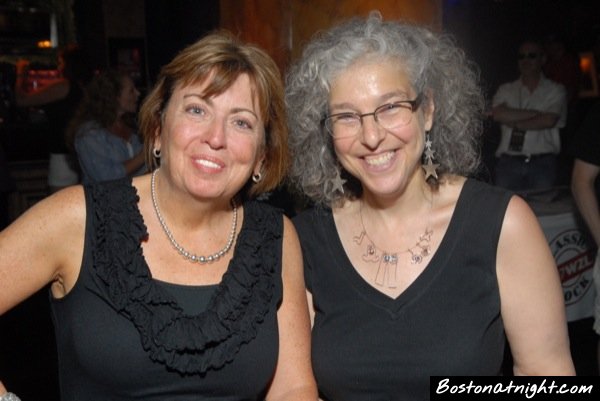
Recently, I had the opportunity to step back in time for an evening, to a charity event for Right Turn, “a creative place for recovery.” The event was at Royale in Boston and featured a bunch of local bands from back in the day. I went with my friend, Susan, who I’ve known since we were both in college and working at the Strawberries record store in Harvard Square with Carter Alan, then an aspiring DJ. Carter, currently heard on WZLX, introduced Jon Butcher promptly at 6:45pm.

me and susan at channel

What followed represented a cross-section of Boston rock and roll from the 80s, from new wave darlings, Robin Lane and the Chartbusters, to everyone’s favorite bar band, The Stompers. The Fools and Lizzie Borden and the Axes played, as did Charlie Farren. Even New England came back together for a set. I said hello to Johnny A., but missed the blues he served up later in the evening because by 10:30pm, I was ready to go. My 7:45am appointment with the endodontist the next morning was a handy excuse, but the truth is, I was wiped. I know I will never be too old for rock and roll—as long as I can be in bed by 11. 

Best pizza ever

There’s no dearth of pizza places in Arlington, and they all have their supporters and detractors. Ask “Who has the best pizza?” on our local email list and you’ll spark a thread as lively as the most heated political debate.

Before I moved to Arlington I lived in Waltham where I was a regular at a joint called Anna’s Pizza. Anna’s made Sicilian pizza, the large square kind with a thicker crust than your typical round pizza. And they were bigger, too. One Sicilian pizza could easily be dinner and lunch for two people. When my roommate and I decided to move to Arlington, we were afraid of what giving up Anna’s would mean in terms of our ability to feed ourselves, but luckily we discovered Nicola Pizza. It turned out that the two pizza places were related somehow (I’ve long since forgotten how). Nicola also made Sicilian pizza, and it was every bit as good as Anna’s. That made the transition to our new town much easier.

nicola

Then along came Andrew whose favorite pizza, Sicilian or otherwise, is Margherita. Margheritas have big chunks of tomatoes (which I abhor) and lots of garlic (which I adore).The taste of the garlic and the cheese almost make up for the icky-ness of the tomatoes, but to this day, whenever we share a Margherita pizza all my tomatoes end up on his plate. Because I love Andrew, we eat a lot of them.

Andrew and Nicola Pizza and I have been together happily for more than twenty years.  Andrew and I are going strong with no end in sight. Nicola, however, ceased operations on June 23. We knew it was coming, but that didn’t make it any easier to say good-bye. After over forty years slaving over a hot oven, Nick and his wife, Mary, decided to close shop.

Over time, I expect we’ll find a reasonable substitute. I don’t think Nicola was the only place in town that made Sicilian pizzas, but then we never had to explore further than our own neighborhood once we found them. With a Celiac in the family now, it probably makes sense to try to embrace a place that will also make gluten-free pizza. There are a few, including one that is highly touted by members of the Arlington email list. Sadly, I’ve been singularly unimpressed by their pizza the few times we’ve tried it.

Even if we find pizza of equivalent quality to Nicola’s Sicilian, nothing will replace the people themselves, most notably, Mary. Anyone who has ever been served by Mary remembers her. She called all of us “honey” or “dahlin’,” but without any real affection. I often wondered if her contempt for her customers was real, or if she really was just being funny. It’s impossible to know, but I sometimes observed her muttering under her breath after a customer had left, occasionally drawing me into her monologue with a raised eyebrow or a chin jerk in the direction of the departed. I would never have dreamed of disagreeing with her. She stood between me and the best pizza in the world. And my family and I will miss them all.

mary and nick