Category Archives: Uncategorized

Is this seat taken?

I got on the MBTA’s red line at Park Street last week, heading for the station at Alewife. It was early afternoon, but the train was filling up; most of the seats were taken and some people, rather than squish in next to strangers, were standing and holding the bar overhead. Those people swayed along with the train. The rest of us were so tightly wedged in that we stayed firmly in place.

Lots of people got off at Harvard Square and by the time we reached Davis Square I had noticed an interesting public transportation phenomenon; no one had relocated to a seat where they would no longer be shoulder-to-shoulder with a stranger, including me. I didn’t change my seat because I was afraid my neighbor would interpret it as a reflection on them. As a result, when the train pulled into Alewife I was still sitting—in the middle of an almost empty car—next to the woman with music leaking out of her earbuds who sat down next to me at Central Square.

It reminds me of something I saw on television many years ago. A man drove his wife to the supermarket and let her out at the front door. Then he drove around looking for a parking spot. He finally found a spot between two vans that turned out to be a very tight fit, so tight that he couldn’t open his door far enough to get out of the car. While he was trying, he dropped his keys and in scrabbling for them pushed them further under the car. Unable to either get out or move the car, he was reduced to holding his unopened umbrella out the car window so his wife could find him when she finished her shopping. When she came out of the store she waited a bit, looked around for him, and finally hailed a cab. As the day wore on the parking lot emptied, except for the two vans on either side of the hapless hero. Once seated on the subway, despite my physical ability to move, I feel as trapped as that man in the car between two vans.

In all likelihood, the person next to me on the subway would take no more notice of my moving than they would of my presence in the first place. And if they did notice, they’d probably just think I wanted a bit more elbow room. After all, the woman who was sitting next to me hadn’t moved either, and I doubt she was worried about my feelings. She was probably just oblivious.

If everyone on the subway started actively engaging their neighbors, would we have a series of interesting interactions, or would it just become one never-ending game of musical chairs? Let’s stop the music and see.
Teach your children well

I always thought of myself as a generous person. I have a list of charities that I donate to annually, and I respond to all kinds of stray petitions throughout the year. Then I got laid off and discovered that what I really am, is a fair-weather contributor. Last year, I cut several of my annual contributions in half, sponsored only one friend in the Pan-Mass Challenge instead of two, and hardened my heart against the General Israel Orphans Home. Rather than feel good about what I gave, I feel ashamed about what I didn’t give.

While my loss of salary doesn’t create a financial hardship for my family per se, it’s hard to ignore the fact that it does substantially reduce our combined income; hard for me, anyway, not my better half. He continues to donate to his chosen charities generously. He doesn’t think we give enough; cutting back on my giving is not something he encourages.

Some of the wealthiest Americans, like Mark Zuckerberg, Bill Gates, and Warren Buffett, have signed ‘The Giving Pledge.’ They’ve agreed to give away half their wealth. That’s mighty impressive. Of course, most of their wealth is ‘on paper,’ and not the kind you spend at the supermarket. If Andrew and I gave away half of our wealth, it could jeopardize our ability to eat during retirement, or buy the dentures we’ll need to do it. Given that medical expenses are the single biggest cause of personal bankruptcies, how can you even know how much you’ll need to retire? Who’s to say that near the end I won’t be tin-cupping outside the General Israel Orphans Home to pay my medical bills?

I’m not trying to make excuses for my recent charitable parsimony, I’m trying to understand it. Apparently financial well-being is as much a state of mind as a reality. I’m confident that when my mind catches up to my reality, I’ll loosen the purse strings again.

In the meantime, our daughter’s allowance is provided with the following caveats: twenty-five percent has to go into long term savings, and twenty-five percent has to go to charity. She puts the money aside and makes her charitable donation at the end of the year. This past year, she had enough to buy a pig through Heifer International. (Pigs provide, “…a valuable source of protein, income from the sale of offspring and manure to nourish crops and soil and increase crop yields.”) Our hope is that charitable giving becomes a habit for her, even if some years all she can afford is a flock of chicks.

Would it kill you to email?

It’s traditional to review ‘the year that’s been’ as we prepare to enter the year ahead. The media does this with top ten lists; I do it by transferring birthdays and anniversaries to my new desktop calendar. This year I am using a Sierra Club Engagement Calendar. I bought it because they say a portion of the proceeds go “…to preserve and protect our environment.” And because I think the pictures are pretty. Ironically, I keep the calendar folded to the current week to minimize the space it takes on my desk, so I only see the pictures for a second when I turn the page.

As I perform my annual ritual, copying birthdays from one calendar to the other, I indulge in my own version of judgment day. Names that evoke a warm response, cause me to wonder how they’re doing, or make me feel happily nostalgic, get carried over to the next year. But if a name causes a negative reaction, no matter how small, then it doesn’t get written into the calendar for the coming year. (I’m not making any John Lennon-like claims about my place in the universe, but it’s hard to miss the similarity between what I do and Yom Kippur.)

My negative reactions are not the result of the person having done something to me. The person has done nothing. They haven’t written or called, Facebooked or tweeted, or even left a comment on my blog. I make it a practice to contact people I like at least once a year. When a birthday appears on my calendar, it’s a sign that it’s time to check in. (These days Facebook keeps track of birthdays, but that’s only useful if you’re satisfied dropping a three-word greeting on someone’s wall. I like to send a card, and for that I need advance notice, the kind you get when you can look a week or two into the future, on your calendar.)

Anniversaries I track include the first date Andrew and I had, and our wedding, both of which are likely to be noted until one or both of us drops dead. I also track the date we brought our cats home from the shelter. Some anniversaries have a finite run. I no longer note the date we closed on our ‘new’ house (fourteen years ago, mid-January, dang, what was the date?), nor do I any longer keep track of the date I quit smoking (which I’m pretty sure was March 10, well over twenty-five years ago).

Transferring birthdays and anniversaries (while important) is also an excuse to review every week of ‘the year that’s been.’ I revisit lunches I had with friends, meetings of my critique group, our bookclub get-togethers and dinners with friends, Hannah’s soccer games and piano recitals, holidays with my family, and vacations with the in-laws. 2010 was a year full of friends, new and old, family, near and far, and the freedom to pursue a dream. It was a good year.

May 2011 bring health and happiness to you and yours. (And don’t forget to check in with me at least once.)

Just because you’re paranoid…

I got in the car this morning to drive my daughter to the bus, and pushed the button that turns on the Prius. Nothing happened. I looked at the dashboard and saw that the only light that had appeared was a small key icon with a line through it. That didn’t do it for me. I said, without expecting an answer, “What gives?” And my fourteen-year-old daughter, who does not drive, replied, “Do you have your purse?”

The Prius has what’s called a ‘keyless entry’; you carry a fob that communicates with the car and as long as it’s in the vicinity of the ignition you’re good to go. The fob lives in a zipped pocket in my purse. I never leave the house without my purse. My purse was in the house.

Last week, I was working out with my trainer, and he demonstrated something he wanted me to do. Then he went to get a floor mat and I immediately forgot the specifics of what he had shown me fifteen seconds earlier.

I recently read a book called Still Alice, about a woman with early onset Alzheimer’s. The protagonist was about my age, but much more accomplished, a professor at Harvard (which underscored how much she had to lose compared to the rest of us). Literary criticism aside, I found the book disturbing, primarily because now I have something else to worry about.

I’ve had a bad memory all my life. I inherited it from my mother, who, by the way, is still sharp as the proverbial tack. I always make lists of things to do so I’ll remember to do them. If I run to the store for a couple of things without writing down what I need, I’ll recite a list of the items all the way there so I won’t forget. I always knew this behavior indicated a somewhat compulsive nature, but I didn’t think it foreshadowed Alzheimer’s.

Since reading Still Alice, that’s all I think about. I fantasize about what life would be like for my husband and daughter if I did have that disease. I wonder if I’d have the courage, not to mention the wherewithal, to check out before it became too problematical for all of us. When these thoughts get overwhelming, I chastise myself for being maudlin and melodramatic. I remind myself that there’s no family history of Alzheimer’s, and the likelihood that I will fall prey to it is slim. Then I remember the old chestnut, just because you’re paranoid doesn’t mean they’re not out to get you, and I start to worry all over again.

Ma Bell’s great-great-grandchildren

How many of you have given up your telephone landline? Keep your hands up if you’re under forty. Just as I thought, people who live in a landline-free home are relatively young. It’s not surprising. Young people don’t even use their cell phones for talking anymore: they text each other. And younger people are not intimidated by a world where each individual has their own phone number because they can remember the numbers! Ironically, they don’t need to memorize phone numbers because they’re all programmed into their cell phones. If they ever need to make a call on someone else’s phone though, they are up the proverbial creek without a paddle because they don’t know the numbers.

The most obvious benefit to a landline is that you only need to memorize a single phone number in order to reach everyone who lives at a particular residence. At eleven digits per phone number, memorizing multiple people’s numbers can become challenging quickly, particularly as you get older.

If age has not yet robbed you of your ability to memorize new data, but you find yourself unable to remember multiple numbers for a single household, the problem might be psychological. For instance, if your grown child, who never really liked you, insists that you check in once a week, you may persist in calling the house number, hoping that your grandchild will answer and you’ll be able to talk to someone who is truly happy to hear from you. If you called your child on their cell, you’d have to talk to them.

And what about emergencies? The landline connects you to the outside world (unless you have my mother’s service provider and live on her street, in which case the phone is often dead, but that’s another post). Cell phones, on the other hand, need to be charged. Mine chirps periodically to indicate that its battery is low. I dread that noise. It signals to the others in the house that I am irresponsible. If my cell phone were a Tamagotchi, I would have killed it long ago.

Unlike men, women do not always wear clothes with pockets; that is why we carry a purse. My cell phone lives in my purse. I don’t, however, carry my purse around the house with me. If my cell phone rings during the day I am unlikely to hear it, or else I will get to it too late to answer it. I have several landline handsets in the house. There is always one close at hand.

Since young people no longer actually talk on the phone, I predict that there will be a resurgence of text-only devices. We’ll revert to carrying pagers. No one will use phones at all anymore. It will be quieter, but we’ll free up our memories for more important things, like where we put our car keys.

Mistaken identity

Growing up, there was another family named Mintz in our town. They must have been more popular in aggregate than my family, because I got used to saying, “No, those are the other Mintzes.” Despite that, I still thought Mintz was a unique name in the universe of last names. That is, until my doppelganger started acting up in western Massachusetts.

I started getting messages on my home answering machine from accounts receivable representatives. “Miss Mintz (this was the mid-eighties and people were still routinely using Miss, and answering machines) your payment is past due. When can we expect a check?” Then collection agencies, who were not as friendly, started calling. “Your account has been turned over to us for collection. Payment is due now.”

Initially I was concerned that I had, in fact, missed a payment or bounced a check, because the caller asked for me by name, and how could there possibly be another Judith A. Mintz out there? By the second or third call I was getting suspicious. When I heard from a hospital that I had never visited, I became convinced that someone had stolen my identity.

At the time, I worked with someone who commuted a long way to our office. He arrived one day with a copy of his local paper, the Berkshire Eagle, and dropped it on my desk. “What have you been up to?” he asked. There, on the front page, was a story about a woman with my name, first, last and middle initial, who had been passing bad checks and otherwise wreaking havoc in the Berkshires. The article included a picture, and it was with great relief that I saw that the culprit was not me!

I contacted a State Trooper named in the article and explained my fear that this woman was going to ruin my credit. He was kind enough to look her up in the DMV records and report back that she had her own social security number, which meant she didn’t need to steal my identity, she had her own.

After that, I started noticing the name Mintz cropping up everywhere. Today, a quick search on the Internet shows that, in and near Boston alone, there are over one hundred Mintzes! While I was relieved to find out that the other woman existed and could be held accountable for her own debts, I was sad to discover that my name was not, after all, unique.

My husband, however, is a different story. His last name is Kleppner. Chances are good that if you meet another Kleppner, it’s a relative of his. If you do, tell them I said hello.

Company Confidential

There was an editorial in The Boston Globe the other day about how nothing you send in email is private. I was disappointed when I read the piece because I’d been thinking about writing about the same subject. If I did, I wondered, would our mutual readers think I was copping ideas from the Globe? Worse, would the Globe think I was muscling in on their territory, using their editorials as springboards for my own? Would they write a piece about bloggers who steal ideas, and name me by name? Would a metro reporter call me for an interview, or even a lowly fact checker, to check a fact? Come to think of it, I’d like that, so I’ll forge ahead.

I started thinking about the futility of keeping email private the day I got one from an old colleague that read, in part, “Did you get the company confidential PowerPoint?” In case you haven’t been paying attention, I haven’t worked for that company in over a year. It would be natural to assume that I had not seen the ‘company confidential’ PowerPoint presentation. That, however, would be wrong. A second ex-colleague had already forwarded the file in question.

If that presentation were instead, say, a ring, which had been stolen by a burglar, I would be in possession of stolen property, and as such could be sent to the hoosegow. (I’ve never seen a hoosegow, but I’m pretty sure I wouldn’t want to go to one.) In that case, I would have the option of asking the person gifting me the ring, ‘where did you get this?’ If they answered that they stole it, I could politely decline. When someone sends you unrequested email, that you’re clearly not meant to see, are you culpable for receiving it?

On a related note, I’d like to point out that printers in public hallways are not secure. If you send a document to a public printer, there is a very good chance that someone else will see it. This does not have to be the result of malicious behavior; it could be an accident. Many were the times that I’d wander the halls yelling, “Who took my freakin’ document?” when something I’d printed disappeared. It was not unusual for someone to scoop up more than their own paper, and then set it aside in their office without looking.

A good friend of mine once inadvertently picked up a memo off a printer that talked about me. Realizing her mistake, she returned it to the printer, after she read it. Then, being the good friend that she was, she told me all about it. It ruined my day. Under the best of circumstances I can’t keep a secret, and this was the worst of circumstances, so I confronted the author and told him I knew what he’d said. Pandemonium ensued (details unlikely ever to be revealed in this blog, proving that perhaps I can keep a secret after all).

Did my friend do me a favor by sharing the contents of that confidential memo with me, or would I have been better off not knowing? I don’t know, but if I do find the answer to that question, I’ll be sure to share it with you.

Rockin’ with NPR

I didn’t know about National Public Radio (NPR) until I was in my twenties. Friends at work would say, “I heard it on NPR,” and I’d nod as if I knew exactly what they were talking about, too embarrassed to ask. Sometimes it was worse. They’d say, “I heard the funniest thing on This American Life.” I was enough of a television addict to know they weren’t referring to a TV show, but I didn’t know what else it could be.

At that point in my life, radio for me was still all about music. I listened to the popular rock and roll stations of the day. I wasn’t living in a complete cultural wasteland when it came to radio. My father was always listening to classical music on WCRB. There was one program I actually looked forward to listening to with him, WCRB’s weekly comedy hour. I can still hum a few bars of, ‘When the Buzzards Come Back to Hinkley,’ a song set to the same tune as the one for the swallows and Capistrano.

Now that I have been listening exclusively to NPR for many years, I wonder why their audience is still so small; why they have to work so hard to raise money. I understand that some people eschew NPR, claiming it’s biased toward left-leaning liberals, but have they ever tried it?

Have the nay-sayers listened to Bill Littlefield talk about sports? He seems to know what he’s talking about, not that I can judge, it is sports after all, but he seems to know an awful lot about the field. He makes it even more appealing from time to time, by delivering the sports news in rhyme.

What about Click and Clack, the Tappet Brothers? Surely there’s nothing to complain about there. Those guys fix cars over the phone, they’re wizards! Who cares if their real life garage is in the People’s Republic of Cambridge?

And Terry Gross of Fresh Air? She interviews all kinds of famous people. Why, the other day she was interviewing Jay-Z. Come on gang, Jay-Z! Admit it; none of you left-leaning liberals out there know who the heck Jay-Z is. She didn’t do that interview for you; she did it for the other guys. So where are they?

If everyone who listens to NPR introduces two of the uninitiated to the station, we can increase the audience exponentially. I suggest we start with people in their mid-twenties who can still stay up late enough to watch Saturday Night Live. Don’t give them the opportunity to pretend they know what you’re talking about. Just send them a link to a podcast from This American Life, along with an iTunes gift card. That way they can have their music, and NPR too.

It’s in the bag

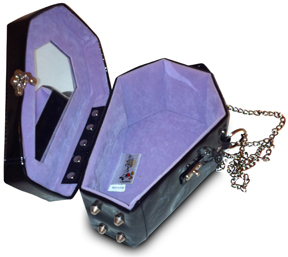
Halloween has come and gone. It’s past the season for my coffin-shaped purse, which only gets used in late October. Yes, that’s right, a patent leather purse shaped like a coffin. It’s slightly marred by the logo for Disney World’s Haunted Mansion, a woman in a maid’s outfit, but I love it anyway.

I only use it in October

I have a tote bag that came from Victoria’s Secret; one of those free gifts they’re always giving away. It has laces that criss-cross up the middle to make it look like a corset. I think it’s clever. I try to use it from time to time, but whenever I dig it out of the back of the closet, I end up talking myself out of it. If I applied my sister’s rule for clothing to that bag – if something hasn’t been used in a year, get rid of it – it would have been due to go to Goodwill about five years ago.

I also have a small Anne Taintor wrist bag that a friend gave me for my birthday. Anne Taintor is a designer who mixes vintage images with modern captions, and then puts them on things. My bag has a picture of an Audrey Hepburn look-alike. The caption is, ‘She saw no reason to act her age.’ That bag gets used considerably more than the coffin-shaped one, but it still doesn’t get out much. The last time I used it was when my daughter and I went on our annual pilgrimage to Fenway. It was the perfect outing for that bag.

We took the subway, which is always an adventure for me. (Each time I get on the Green Line to Kenmore Square, I worry that I’ll end up on the one branch that doesn’t go there. Given the crush of humanity that uses the T to get to Kenmore Square on game days, it seems unlikely, but I worry nonetheless.) That day, we ended up on one of the trains that bend in the middle, and that’s exactly where we stood. I got a big kick out of it. My daughter rolled her eyes at me. I pointed at my bag, ‘She saw no reason to act her age.’

Recently, I went to the web to see what other things Anne Taintor designs. I discovered that my bag is actually meant to be used for cosmetics. Does that mean that the message, ‘She saw no reason to act her age,’ is meant to be seen only when I apply makeup? If so, it would get less use than the coffin-shaped bag. It might even have to join the corset bag in the back of the closet.

Upon reflection, and in keeping with the sentiment on the bag, I’ve decided to continue to use my Anne Taintor bag as a wrist purse. The corset bag, however, will remain in the closet, at least until my next trip to Goodwill.

Saying good-bye to old LPs

If you saw my record collection, you’d probably think it was pretty big, and by today’s standards you’d be right. Most people got rid of their records a long time ago. Me, I never bought a CD player. I did finally acquire one through marriage. You may recall that my husband is somewhat younger than I am. He had CDs, I had records. Oh, he brought a few albums with him (which is how we ended up with two of the Beatles White album), but not enough that we would ever refer to it is our record collection. They were mine.

They were especially mine when he wanted to get rid of them. They took up space, the stereo cart was old and ugly, and besides, he complained, did I ever actually listen to them? He had me there. One birthday he got me a record player with a built-in USB, and a gadget that would let me play music from the computer upstairs, in the living room downstairs. All we had to do was digitize my records. That was a few years ago and we never got further than the letter C, at which point the magnitude of the project overwhelmed both of us.

I’ve finally started to wean myself from my records. When I’m in the mood, I comb through the collection and pull out a few more I’m ready to part with. In the beginning, I did it grudgingly, but recently I’ve been picking up steam. I loved the Alan Parsons Project, but I could only sing the songs from Eve, so did I really need the others? Wasn’t it time to admit I’d outgrown T. Rex? Actually, the answer to that is no. I put it back on the shelf.

Now what? I could drive all the way to Norwood to sell them to Newbury Comics for fifty cents a piece (“No Eagles, please,” as if I’d ever sell my Eagles records!), but I didn’t need the money badly enough to schlep down there. I just wanted to find someone who would give them a good home. It turns out that there is a woman in my town who has a real collection, somewhere in the vicinity of 10,000 albums. She collects, and trades, and, here’s the corker, listens to her records. When she left with a box of LPs culled from my collection, she said, “If you ever just want to listen to one of your records, bring it over and I’ll play it for you.” If I’m too lazy to lift the arm of the turntable, I’m probably not going to go over to her house to listen to music, but that’s the kind of person I was looking for.

Slowly but surely I’ll whittle away at my collection until I’ve got it down to records I could never, ever part with; Bonnie Raitt’s Home Plate, Supertramp’s Breakfast in America, Livingston Taylor’s eponymous first album. Once I’ve done that, I’ll go buy them on iTunes so maybe I’ll actually listen to them. How about that, I never did need a CD player.