Category Archives: Uncategorized

I no longer hav a hart

One night, many years ago, when I was young and living in an apartment in Waltham, I heard a scrabbling sound. I searched the apartment and had just about run out of places to look when I thought to open the broiler drawer at the bottom of the oven. And there it was, a field mouse. As I remember it, the mouse and I both squeaked and recoiled, but maybe it was only me, it was a long time ago.

I do remember that it was too late to buy a trap that night, so my boyfriend drew a little picture of a skull and crossbones, scrawled keep out on it, and tacked it to the bottom of my bedroom door. The next day I purchased a Havahart trap and caught my mouse, alive and well. On my way to work I relocated him to Billerica and that was the last time I had to deal with a mouse in my own home.

The other weekend, I hosted a writer’s retreat at my in-laws house in southern Vermont. It’s an ideal spot for creating, with cozy nooks for writing and beautiful views for inspiration. It’s perfect in every way, except for the mice. If they stayed out of my way I would share the space with them, albeit a tad grudgingly. After all, this is a country house, in the middle of the woods, and it spends a fair amount of time uninhabited. Someone should make use of it. And there is ample evidence that the mice do. Fortunately, they are quite small so the – evidence – is proportionately small. When, however, a mouse has the audacity to run across the floor in full view of my guests, I have to put my foot down.

Normally, I happily bow to gender stereotyping and leave the mouse trapping to the men. On this particular weekend, though, I was the hostess and the job fell to me. I read the instructions and set a couple of traps. We had no peanut butter, which is what the trap manufacturer recommend using, so I baited the traps with a lovely quiche that my critique partner, Vicki, had made. In the morning, I came downstairs and Pamela said, “Congratulations. You caught a mouse. I left it for you.”

I threw a paper towel over the trap and mouse, and then picked it up by a plastic tab designed for just that purpose. I opened the trash can in the mud hall and held the trap over it. I had no idea how to get the mouse out of the trap. With my free hand, I picked up the instructions and tried to make out the small print. I may have been going into shock because I have no idea how I finally figured it out, but there was a quiet plop as the mouse fell into the can, and the trap lightened. I then gave in to a small post traumatic response. I pulled my chin in and down, shivered and shook my shoulders (you’d recognize the behavior if you saw it). Then I pulled myself together and returned to my colleagues.

Once the horror of what I had done subsided, I felt rather proud of myself. I had done what needed to be done, and lived to tell the tale. When I was young, killing a mouse would have been unthinkable. Now that I’m older it seems quite reasonable. The house really isn’t big enough for all of us.
Impulse buying

I’ve been feeling a little out-of-control lately. I’m not sure what happened, but something went tilt and I’ve been compulsively eating caramel-flavored candy corn. It’s probably the fault of the Halloween season; it taxes my ability to resist buying candy, even though I spend the rest of the year practicing.

Most registers at my local Stop & Shop (or as my friend Rebekah calls it, Stop & Rob), have a rack of candy and gum conveniently positioned for impulse buying. If I’m lucky, I end up at the register that offers “healthy” distractions, like dried fruit and corn puffs in a can which interest me not at all. But it doesn’t really matter, because I’ve gotten quite good at restraining myself. Once in a while I’ll pick up a York Peppermint Patty and contemplate getting the sensation, but then cooler heads prevail and I put the patty back on the rack.

Unfortunately, impulse buying is not restricted to items placed strategically near the cash register. Frankly, those that are are typically small money, so while you might chide yourself afterwards it’s unlikely to rise to the level of full-blown buyer’s remorse. For that you need to dig a little deeper into your pocket. Like the time I bought a pair of three hundred dollar orthotic inserts from a chain called Good Feet.

My feet were bothering me. A friend had recently told me that he had plantar fasciitis, and I’d developed a sympathetic case. The Good Feet store in Lexington had a big sign in the window that said “Plantar fasciitis,” so on a whim I stopped in. Now, I’m a tad nervous about inviting a defamation lawsuit, so I’ll try to stick to the facts, but I will say that this franchise ought to be illegal. In order to purchase these slightly molded, plastic inserts, which probably cost fifty cents to make, I had to sign a document that said I understood that they were non-refundable – for any reason. This was not a parenthetical comment at the end of the receipt; this was a separate document. The non-refundable policy was also prominently displayed at the cash register. It was the polar opposite of an impulse buy setting. It was the “anti-impulse buy.” And yet…

I wore those inserts for one day. They hurt my feet. I put them in a drawer for a respectable amount of time, and then I got rid of them. I’ve blocked how; Goodwill, garbage, I don’t remember.

Typically, I suffer buyer’s remorse after what I call a shopping accident, which is what I say I had when I spend too much money on something I need (or want). I could choose to remember the Good Feet debacle as the mother of all shopping accidents, but for some reason it haunts me as my most egregious impulse purchase instead.

It seems appropriate, during this season of haunting, to remember that humiliating experience and to ask myself how many bags of caramel-flavored candy corn I could have bought  for the price of those orthotics.

Volunteer vegetation

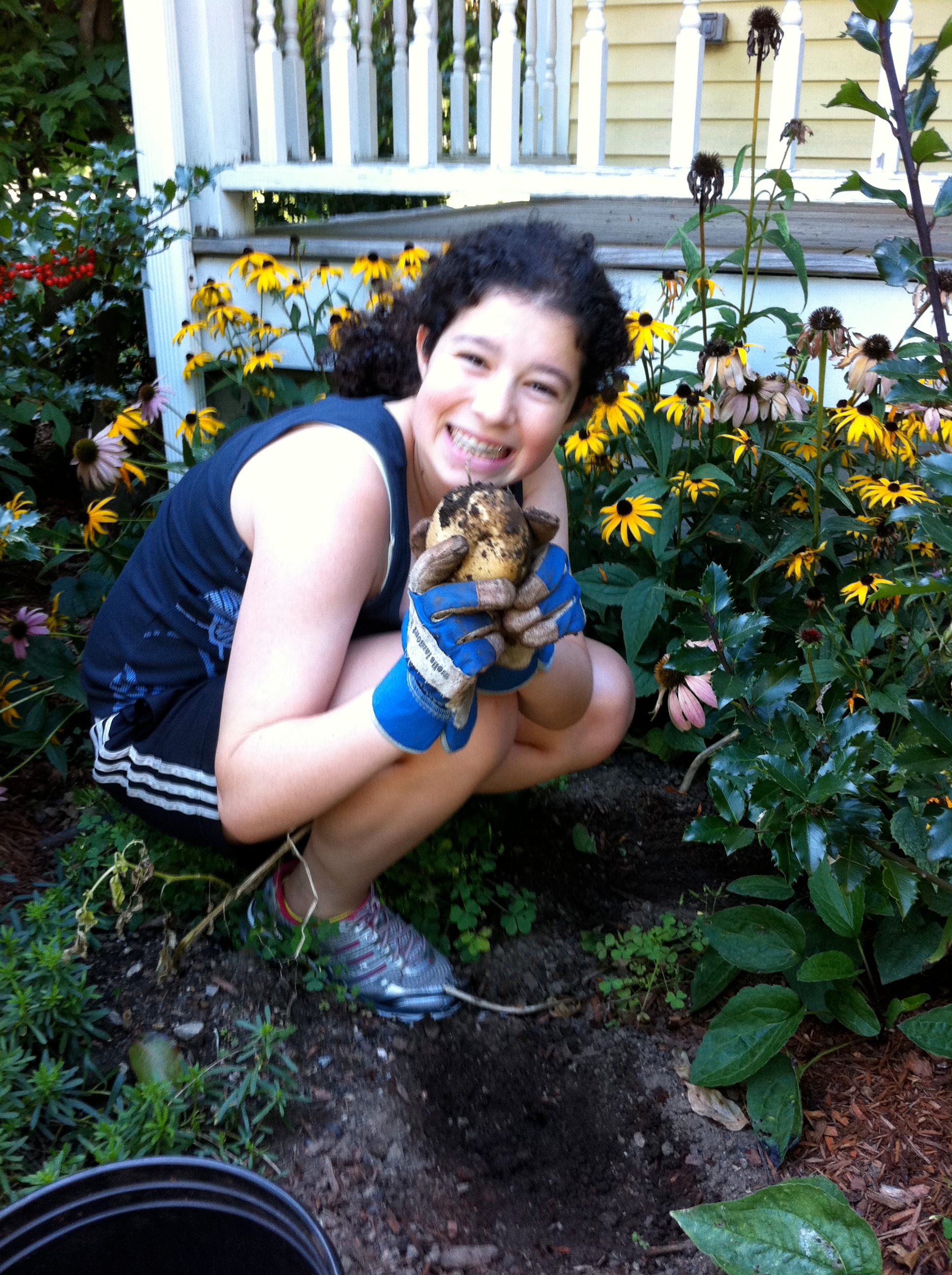
This is the second year that Andrew and Hannah have planted potatoes. We don’t have a dedicated vegetable garden so they picked a spot that looked promising and planted them right in between a couple of flowering, decorative plants in the front garden. As it happens, potatoes have lovely leaves and pretty flowers. To the unsuspecting, they looked like they belonged right where they were. The first year’s yield was quite impressive as you can see by this photo of a grinning Hannah.

This year, Andrew and Hannah added two more locations, but were a little disappointed by the crop. The potatoes were quite a bit smaller. But if we step back a bit, you’ll notice something interesting about this part of the yard. All those big leaves running along the side of the garden bed? Squash. They didn’t plant squash, but there it was. We thought it was a miracle – immaculate conception, squash-style. Only it wasn’t. It was compost.

We have a big plastic compost container in the backyard that gets fed all our vegetation and non-meat scraps, as well as all the clippings from Andrew’s pruning projects. It just sits there, quietly rotting away, and every once in a while, Andrew stirs it with a pitchfork looking every inch like one of Macbeth’s witches at his cauldron. Then, when planting season arrives, he puts a healthy supply of his home-grown compost in with the new bulbs or shrubs or what-have-you’s.

Last year, Andrew discovered a great recipe in The Boston Globe for pasta with butternut squash, shrimp, feta, and lemon. It was a big hit, and a lot of butternut squash seeds made their way into the compost bin. The rest, as they say, is history. We thought this was an amazing story and shared it with friends. It seems that this was not all that unusual an occurrence. They had grown tomatoes the same way. They called them their volunteer tomatoes.

Initially, we thought we had started a pumpkin patch. It wasn’t until the squash blossoms appeared that we realized our mistake. We watched the squash grow from tiny little knobs of green to large, light-orange gourds. Andrew nurtured them as carefully as anything he ever planted on purpose and last weekend he used our volunteer squash for our favorite pasta recipe. It was delicious.

We do, however, have quite a few butternut squash to use. I’m a little concerned that we’ll tire of our favorite dish long before the squash are gone. Volunteer squash, anyone?

Tooling around on a Segway

Right before her birthday this year, my mom bought herself an Android-based tablet. Had it not occurred to her, I asked, that that would have made a good gift for one of us to give her? She was genuinely surprised because in truth the answer was no, it hadn’t occurred to her. My mother is the consummate consumer, which does not mean she buys a lot; it means she thoroughly researches everything before she purchases – anything. I probably wouldn’t have gotten her one anyway, for fear of getting the wrong one.

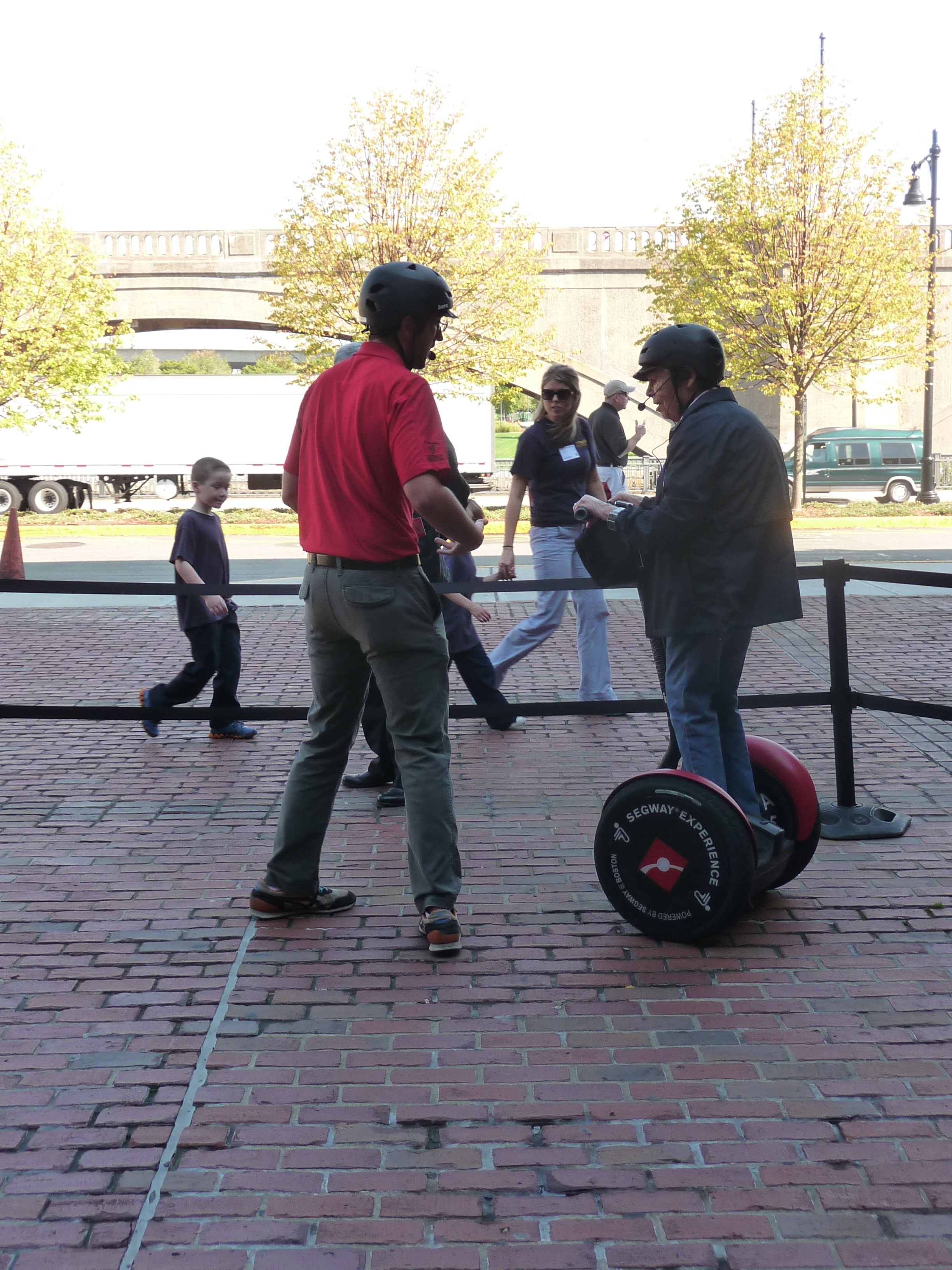
Instead, I gave her an outing that I was pretty sure would appeal to her inner geek, a ride on a Segway. I considered renting one for a day and having it delivered to her house, but decided that it might be more fun if we did it together so I opted for a tour. The tour operator, Segway of Boston, works with the Museum of Science and tools around Cambridge where it’s legal to ride on the sidewalk.

The first half hour is for training. We watched a short video where an animated figure showed us all the things we shouldn’t do, lest we end up splat on the ground like he did. Then we were given a headset with an earpiece and a microphone. The receiver, clipped to our pocket, had a talk button on it. To use it, however, we’d need to take one hand off the handlebars, which was one of the no-no’s in the video. I resolved to keep my comments to myself.

The hardest part of using a Segway turns out to be getting on, rivaled only by getting off. Apparently Segways are never really at rest; they are always moving, like a horse that’s new to being under saddle. In order to get it to stand still you need to have it perfectly balanced. If you push the handlebar forward it goes forward, pull it back it goes backward. Fortunately, the Segway can’t smell your fear, and once on, it didn’t take long before we were all happily scooting around the practice area.

Then it was time to head out. The tour, led by a recent Skidmore graduate named Aaron, was a blast. He kept up an amusing and informative narrative. It wasn’t long before I was comfortable enough to use the talk button so I could let him know he was being appreciated. He took us across the Monsignor O’Brien Highway to North Point Park, a beautiful spot that we were told was created as part of the big dig. Then we went up to North Point Boulevard where they’re building the big skateboard park. After that, we crossed back over the highway and cruised down to Memorial Drive where he pointed out Beacon Hill across the river and told us about the buckets of tar that were lit in the event that the people needed to be alerted, hence the name. Next we rode into the MIT campus and paused for a break while Aaron showed us pictures on his iPad of famous MIT hacks. Then it was back to the museum.

When personal Segways were first introduced, they cost about $30,000. Today, you can get a new one for $6,000 and a refurbished one for $3,000 to $4,000. If you calculate how much you spend in gas to run errands around town, it might take a while to pay for itself, but what’s it worth to not have to actually walk when you take the dog out? For all I know, my mom is already doing the research.

The meaning of life

Last week’s blog post was so stupid that I thought I should atone for it by writing something serious, and what could be more serious than death? I’ve been thinking about it a lot lately because my high school graduating class has lost a number of people this year. I had a big class, almost 800, so maybe losing four or five isn’t that out of whack, statistically speaking, for my age group, but it sure feels like a lot. I’ve written about what a lousy system the whole birth/death thing is before, but this time I’m going to focus on what really bothers me, and that’s how we Jews are supposed to come to terms with death.

I know we don’t believe in an afterlife, but I worry that I missed something critical while doodling my way through Hebrew School that would have helped me understand how we’re supposed to deal with death and the associated grief, from a religious perspective. Of course, this needs to be framed by the fact that I’ve only recently graduated to agnosticism from my earlier stance as an atheist. Despite my position, I am jealous of those who benefit from the comfort that faith can provide. I admitted this bizarre dichotomy the other day, during a class called Judaism and Critical Thought, taught by my Rabbi, Rim Meirowitz. And wouldn’t you know, it turns out that Judaism offers coping mechanisms that even a non-believer can embrace.

Rabbi Rim explained that for Jews,”… life after death is found in the community remembering the deceased.” My first response was, well then, it’s not life after death is it? They’re just as dead. But Rim went on to explain that we create occasions to remember, like Yahrzeits (the anniversary of the death) and Yitzkor (a service performed four times a year). And just like that, I understood. We continue to honor and respect our dead for as long as we are alive.

I felt an overwhelming sense of relief; I felt comforted, like a person with faith. The most surprising part of this epiphany is that these things we do, Yahrzeits and Yitzkor, are not new to me. Each month the temple publishes a newsletter with the list of Yahrzeits, we recite the mourner’s Kaddish at services. Why did I never appreciate the power of these rituals before?

Rabbi Rim is a smart, well-read guy, so I’m sure he was quoting someone else when he suggested that faith is based on an individual’s willingness to create the meaning of life for him or herself, and then forget that they created it. I’m still not willing to take the next step and proclaim a belief in the one whose name we should not write, according to Jewish practice (and no, I’m not talking about Voldemort), but I do like the idea of constructing the meaning of my own life.

The act of telling stories about my life, my friends, people I care about, people who have influenced me, people I don’t know, gives my life meaning. Mind you, I don’t know what it means, but I’ve still got time to figure that out.

People Magazine or The New Yorker?

My friend George likes to push the envelope, any old envelope will do. He’s always got a one-liner ready to go and he can’t resist a good comeback. We clicked as soon as we met, probably because I’m a lot like him. I knew he was just trying to be provocative when he suggested I do a post about how long people spend going to the bathroom, but it worked. I’m going to give it a whirl.

Remember the movie, The Big Chill? It’s one of my all-time favorites. In case you never saw it or don’t remember it, a bunch of friends from college get together for the weekend after one of them dies. It had a phenomenal cast and even better music. (It’s a little known fact that the corpse at the beginning of the movie, whose head is never seen, was played by Kevin Costner.) Jeff Goldblum was in it, a very young Jeff Goldblum, and a very young Kevin Kline, and, face it, the movie came out in 1983, they were all very young; Glenn Close, William Hurt, Mary Kay Place, Tom Berenger. I loved them all. I wanted to belong to a group like that so badly. I still do. Sigh.

Jeff Goldblum played a character who wrote for People Magazine. He said his job was to write pieces that were short enough that the average person could read one in the time it took to take a crap. I tried to find the exact quote on the web, but after half an hour I’m giving up. I thought that line was hilarious so why doesn’t it  appear in any of the lists of Big Chill quotes? I guess it wasn’t that funny. It was, however, the first thing I thought of when George challenged me to write about the time people spend on the pot.

The next thing I thought of was the children’s book, Everyone Poops. By the time it was published in 2001, we’d already established that fact with my daughter so I never felt the need to explore that book further than the title. Then, a couple of years ago, I read Augusten Burroughs’ Running with Scissors. That’s a memoir about a truly bizarre childhood. His mother couldn’t cope, so she sent him to live with her psychiatrist, who was crazier than she was. (Running with Scissors has been made into a movie as well, and while they did a decent job of bringing it to the screen, if you haven’t seen or read it, I’d recommend that you read it.) The patriarch of the family, his mother’s psychiatrist, is fascinated by his poop (his own poop). He scoops it out of the toilet, intact, and puts it out in the yard to dry so he can study it. Mind you, we’re never told how long it takes him to produce the poop so perhaps it’s not relevant, but it popped into my head and there it is.

This is the point where I usually manage to cough up something that will tie the threads of the blog post together; some reference that will make the reader go ahh, or ah ha, or maybe just ha ha. I’m having trouble doing that this time. Maybe it’s because I’m feeling a little rumbly in my tummy and it’s distracting me. I know what to do; I’ll take a break and go to the bathroom. Now then, where did I put the latest New Yorker?

Take a seat. No, not that one!

Flying is getting more surreal each time I do it. You make your own reservations and check yourself in. If you want to eat on a plane, you bring your food with you. A checked bag is twenty-five dollars – each way! On our recent trip to Wyoming, that added $150 to the total cost. Or it would have if my husband hadn’t figured out a way to beat the system.

While waiting for our flight out, after we’d already checked our bags, the gate attendants repeatedly requested that passengers check their bags because the flight was running out of storage space in the overhead bins. Before they called our group to board (which they organize by some algorithm that I’m clearly not smart enough to understand) they announced, “If you have carry-on luggage, you must surrender it now so we can check it; the plane is full.” There was much grumbling about the inconvenience amongst those still waiting to board, but no one complained about the cost, because now it was free.

On the way home, Hannah and I checked our bags, which were too big to carry on anyway, but Andrew held onto his. Once again, when it was time to board, the announcements started. “This is a full flight and there is not enough room in the overhead bins. Please let us check your bags for you.” Andrew marched right up and handed his over. His bag was sent to join ours and we saved $25. Ha, take that United!

But bags aren’t the only thing you pay for. You want a window or an aisle seat? That’ll cost extra. Traveling with a child? Didn’t spring for the cost of an aisle seat? Well then, there’s no guarantee that you’ll be able to sit with your child. That’s insane! Believe me, there isn’t an airplane passenger in the world who wants to sit next to someone else’s abandoned kid. Come to think of it, some of us might even pay extra to ensure that that doesn’t happen…

I don’t know how we managed since we didn’t pay for the privilege, but the three of us were seated together on all four legs of our vacation flights. On the second leg of our trip home, the plane wasn’t terribly full. I was in the middle seat. As soon as I sat down I started scoping out a replacement seat. There were a few empty rows, and a few that just had one person in the aisle or the window. Things were looking promising. They shut the door; no one else would be getting on. I began checking out the competition. I knew that everyone else in a middle seat was thinking the same thing I was. The flight attendant picked up the intercom.

“Hello everyone. Looks like we have some room on the flight this afternoon so as soon as we’re in the air, you’re free to move. However, those of you in the back of the plane, please do not come any further forward than row x.” Apparently, those people paid more for their seats. In the good old days, there would have been a curtain to provide a visual clue, but no more. Then, to add yet one final insult, the flight attendant came over the intercom and said, “And if you have to use the restroom, please use the one at the back of the plane. The ones forward of row x are not for you. Enjoy your flight.”

Wyoming III: White water rafting

Most of the people we met in Wyoming were from somewhere else. I’m not talking about the seasonal employees at the National Park’s visitor centers or the international students who work in the restaurants and gift shops. I’m talking about the people who call Jackson home. One of the paragliding instructors told us he’d been there about ten years. In addition to floating off mountains, he has a full time gig as a janitor. He said it was a great place to raise kids and he was there to stay. We met a waiter who’s been there for two years and is trying to launch a career as a photographer, not a super young guy, in his early thirties. His girlfriend followed him out and they got married. He said the town is a mecca for kids fresh out of college. They work for a couple of years and then move on – or not.

White water rafting with Andrew and Hannah

The most interesting transplant we met was John, our white water rafting guide with Barker-Ewing. John is originally from Connecticut, but has been living out west for fourteen years. He’s an outdoor adventurer who cobbles together a living leading rafting and kayaking trips down the Snake River and anywhere else you can float. He’s saving money for a trip to Ecuador where there’s a river waiting for him. I’m not sure what he does to earn money in the winter, but when the snow falls, he hits the slopes.

John does a lot of what’s called back country skiing, or skiing out-of-bounds. That’s just what it sounds like, skiing where there are no trails; where if you break your neck they may not find you for a while, which is what happened to him. Luckily he had cell reception and was able to call for help.

Another time, he got buried in an avalanche. He said it was like being in cement, he couldn’t breathe. Just as he started to see colored lights, indicating that his oxygen was almost gone, the friends he’d been skiing with were able to dig him out.

He shared these stories with us while we were floating down the Snake River in an eight-person raft. He was entertaining, but I wondered if there were rafting-related misadventures that he was keeping to himself. I’d never gone rafting before and I’m not embarrassed to say that I was scared. This trip, however, began with a benign two-hour float, followed by a stop at their campsite for breakfast. The float was so beautiful and relaxing (although cold in the morning), and the breakfast was so delicious (rice flower pancakes, maple-flavored sausage, perfect coffee), that I figured I’d at least die happy when we hit the white water.

There were two guys from Atlanta with us on the raft. One, also named Andrew (the spitting image of Robin Williams, don’t you agree?) had moved to Cheyenne for a job with an environmental firm a couple of years ago, and the other, his friend Dixon, a radiologist, was visiting him. When I found out we had a doctor on board I definitely relaxed.

Can you tell which one looks like Robin Williams?

As it turned out, Dixon’s services weren’t needed. The country’s been having a drought, and the Snake River was not in a raging kind of mood. Oh, there was white water, and we had our thrills and got wet, but it could have been much worse. Considering that we weren’t wearing helmets, it’s probably just as well. John had clearly had a lot of luck in his life; I didn’t want to be around when it ran out.

If you’re going to Wyoming and want to do some rafting, I’d recommend Barker-Ewing. But don’t confuse them with Barker-Ewing Float Trips. The only difference is the hyphen in the url that our outfit has. Apparently Barker and Ewing were together for many years. When they finally split up, the hyphen free crew decided to stick with lazy trips, floating tourists around and pointing out bald eagles and such. Our company got the hyphen and the franchise for the white water trips, and the campsite where they serve their incredible breakfasts.

Wyoming II: Paragliding with the stars

Andrew has floated in a hot air balloon, cruised in an open-air bi-plane, and jumped out of a plane, so I wasn’t terribly surprised when he said he wanted to go paragliding in Wyoming. I was, however, floored when, without consulting me, he asked our sixteen-year-old daughter if she wanted to do it, too, and even more surprised when she said yes. I, of course, said no. (That’s what comes of having been a wild middle child; I have nothing left to prove.)

On the second day of our vacation, we were at the paragliding meeting site at 7:45am. When the thrill seekers got on the tram to go up the mountain, I wandered down to the landing site, which happened to be in the hotel’s front yard. Since this was not my adventure, I have no firsthand experience to share about anything that happened out of my sight. I can, however, show you some photos I took of Andrew and Hannah heading out, floating around, and landing. You’ll find those below. But that’s not what my story is about.

After Andrew and Hannah landed, and the pictures had all been taken, we walked back to the Village for breakfast at The Mangy Moose. Over Huevos Rancheros, Hannah told us that her paragliding instructor had let slip that at the 9am launch they were gliding with Stephen Colbert. To verify that, she poked around the web and came up with a Colbert tweet that said “‏@StephenAtHome I’m on vacation for a week. I won’t say where, but it rhymes with Florida. That’s right, I’m going to the secret rich person island Shmorida.” I reacted like a bear after huckleberries during the drought. I wanted to see Stephen Colbert.

Andrew and Hannah were game, to a point. We walked back to the landing site together, right on time to see the 9 o’clock group descending. The scene on the ground was the same as the one we had participated in an hour earlier. There were a handful of people with cameras trained on the sky waiting for their loved ones to land. There were no paparazzi, no fans with autograph books; nothing to indicate that this was anything other than a normal gathering to watch crazy people fall out of the sky.

While we watched, I struck up a conversation with a woman who turned out to be from Newton. She and her two children were waiting for her husband to land. Once her husband was safely on the ground, they left, leading me to believe that they were unaware that Stephen Colbert was among their group. That, or they were just too cool for school and didn’t care. By the time Mr. Colbert landed, there were only a few people left at the site. It was the ideal setting in which to accost a celebrity.

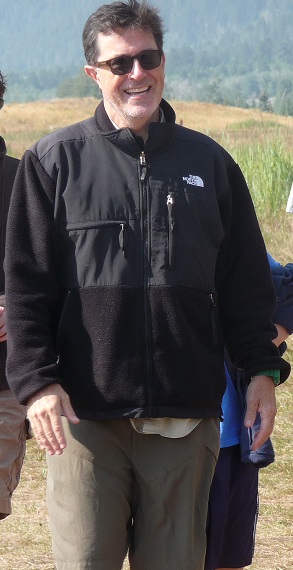
Andrew and Hannah were standing off to the side pretending they didn’t know me as I slid closer to Mr. Colbert. I waited until he was out of his gear and seemed to be wrapping up. Then I walked up to him, held out my hand and said, “Judy Mintz. And may I just say, Florida Shmorida.” He shook my hand and nodded without paying too much attention. I was just another fan, nothing special, nothing interesting. I stepped back. When he stopped to pose for a photo for one of the paragliding crew, I snapped a few pictures of my own.

Stephen Colbert purports to hate bears, which makes Wyoming a strange vacation choice since it’s peppered with signs warning you to be “Bear Aware,” and tourists are encouraged to carry Bear Spray. Despite all the warnings, we never saw a bear. Maybe Mr. Colbert knew his chances of seeing a bear were slim compared to the likelihood that he’d be bothered by a fan. Maybe he packs Fan Spray. If so, I’m glad he didn’t consider me a big enough threat to use it.

Wyoming 1: Wildlife and Yellowstone

Andrew worked hard to plan our vacation in Wyoming. He researched flights and hotels, studied Trip Advisor for places to go and things to do, and poured over Google maps. Now I get to tell the stories. However, there’s no way to recount a week’s vacation in a single blog post, so you’ll have to bear with me.

Our flight out included a stop in Chicago. While loitering in the terminal there, I observed a family that caused my antennae to go up. The patriarch was a youngish man, maybe in his late twenties, with neatly trimmed blond hair, wearing a blue t-shirt emblazoned with the American flag. He was corralling three boys, all mini versions of himself, none older than eight or ten, each one wearing the same t-shirt. When the mom came out of the restroom, she was trailing a little girl and pushing an even littler one in a stroller. All three were wearing the same t-shirt as the boys, but the mom’s was red. Where I come from, a family of this size, in matching patriotic garb, is  unusual, and therefore notable. It was like a wildlife sighting; the first of our trip.

We spent the first day touring Yellowstone National Park. It was unlike anything I’d ever experienced. Everything we encountered was a delightful surprise, from the herds of bison to the pools of boiling, bubbling water; from Artist Point at Canyon Village where we saw the yellow stone that the park is named after, to the waterfall at Uncle Tom’s Trail. All the vistas were unique, each more awe-inspiring than the one that came before.

There are lots of hot springs inside the park, some surrounded by glorious rings of color. We were following a boardwalk around one of these springs when I saw a young, blond man wearing a red t-shirt with the American flag emblazoned on it. The boys who accompanied him were wearing the same t-shirt, as was the woman following behind. I was flabbergasted. It was the same family! I approached him and said, “Aren’t you missing a few children?”

He looked vaguely startled and answered brusquely, “No.”

“Really?” I asked. “But when I saw you in the airport you had more children with you.”

He ignored me and kept walking. His wife was far enough away that she hadn’t overheard our conversation. I tried again. “Aren’t you missing some children?”

She smiled absent-mindedly and said, “Oh, no.”

“But when I saw you in the airport you had more children with you.”

“We didn’t fly, we’re from Utah. We drove. But yes, I left the young ones in the van with their grandmother so they could nap.”

“Are you sure I didn’t see you in the airport?” I persisted.

“No, no,” she responded, pleasantly enough, “we drove.” And she walked past to catch up with the rest of her family.

Andrew and Hannah were horrified, and rightly so. I sounded like a stalker, or worse, a kidnapper! What was I thinking? In hindsight, they were clearly not the same family. The man in the park was definitely older than the one in the airport. There was no grandmother with the original group. And, as Andrew pointed out, the family I’d seen in Chicago could have been flying anywhere in the world. But why, then, did the mom tell me that there were other children in the van… It doesn’t matter, there’s no excuse for my crazy behavior. My desire to make a connection was stronger than my sense of propriety.

People behave in strange ways inside Yellowstone. There are signs posted all over informing visitors that they should keep a healthy distance from the wildlife, and yet, as you can see from the picture below, that advice is regularly ignored. Next time, I’ll be more careful.